Showing posts with label 1910s. Show all posts

9 Jan 2018

Happy New Year from Yesteryear

As the New Year is kicking into gear, and our idea of the obligatory New You is following suit, it is all too tempting to map it out of Brand New Things as opposed to just New Things! Now hold on. How about turning back the clock, especially as far as those vintage French New Year fancy cards (a.k.a. mignonettes) are concerned?

Bonne Année (1908)

The design of those yesteryear cards bears more gusto and compulsion than today's watered-down/ minimalistic representations. Look at those freestyle calligraphic fonts embossed in gold dust and swathed in flowers, a call for Spring in the thick of Winter: how dainty and desirable are they!

Bonne Année (year unknown)

Picture the scene: you get ready for breakfast, check the post as coffee is percolating away, and bring back half a dozen of those adorable mignonettes from the letterbox to your kids and spouse. Open them together and relish on the sweet words sent out to your family by other loved ones, as you sip café au lait and munch on chocolatines. Rejoice in the knowledge that the senders are receivers too as they too are experiencing the tokens of family joy which you sent them. 

Happy New You, Y'All!

Bonne Année (1912)
Bonne Année (1909)
Bonne Année (1906)
Bonne Année (1908)

Source: Move over, eBay, the big boys are in town! Delcampe is the specialised ephemera auction site from Belgium that describes itself as the greatest marketplace for collectors, with a current offering of almost 80 million items from the world over - I kid you not!

Postcards (> 46.4 million items to choose from!), postage stamps (> 22.8 million!), books, magazines and comics (> 2.6 million), old papers (> 2.5 million, anything from autographs to invoices and lottery tickets!), numismatics (> 1.1 million!), and other collectibles (> 3 million, including photography, advertising and music). From the commonplace to the rare collector piece, from the affordable to the extravagant, from the dilettante à la Mirabelle to the serious hobbyist à la J. Paul Getty, Delcampe has it covered.

Bilingual, so why not? A Happy New Year (1908)

You may kickstart your collecting career with less than five dollars to spare, making you the proud owner of a 100-year-old greeting card (see above). Collecting has to start somewhere and it might as well start with those as the risk factor is close to nil. Note the strong use of symbology for love, luck, happiness, peace, eternity and prosperity: heart, four-leaf clover, horseshoe, lily of the valley, dove, forget-me-not and mistletoe. (1) Bonne Année greeting card from 1908. (2) Bonne Année greeting card (year unknown). (3) Bonne Année greeting card from 1912. (4) Bonne Année greeting card from 1909. (5) Bonne Année greeting card from 1906. (6) Bonne Année greeting card from 1908. (7) A Happy New Year greeting card from 1908. Cards (1) to (6) are still available to purchase.

25 Nov 2017

The Art Déco Redesign of Saint-Quentin

It is high time Mirabelle paid its dues to a northern French Art Déco town which holds a special place in my heart: my hometown of Saint-Quentin! A born-and-bred saint-quentinoise, I spent my formative years there. I moved away for college before returning briefly home (for three years), and then onto the next leg of my personal journey, the UK.

Most of my family still lives in Saint-Quentin. My parents relocated to Corsica ten years ago and I followed suit from the UK approx. three years later. When my dad left Saint-Quentin, he left his heart behind - and probably even his soul. I left bits of myself behind and fragments of my heart too. Whether we acknowledge it or not, we all leave bits of ourselves behind whenever we up sticks.

Nouvelles Galeries, rue Saint-Jacques
ibid.
ibid.

We are ambivalent as to whether we should have moved away, whether we should have moved on with our lives. For my dad, this has proved virtually impossible after he was forced to sell our much-loved family home, a one-of-a-kind (unique) property whose elaborate construction and overall design he had been personally invested in every step of the way over the course of almost 35 years. A painstaking labour of love carved out of the best materials, using the best skillsets, that makes the house he lives in now a mockery (his words) if only in terms of architectural merit.

Mosaic ribbon (detail), rue de la Sous-Préfecture; another element of the façade is shown on pict. (13)

The irony of it all is that through our time in Saint-Quentin, none of us hardly took any photos of the town itself, none of us photographically recorded its beautiful, history-laden architectural heritage which was the background to our every day. A faux-pas which I reiterated in Manchester! So once again, I find myself reliant upon other people's photography in order to relate a part of my personal, intimate history.

Trade 'Commerce' medallion on a façade, rue de la Sellerie, carved out by French sculptor Raoul Josset

The moral of the story: do not take for granted the locale you live in. Pay attention to it, observe it, acknowledge it and immortalise it with your camera (or your paints and brushes or pencils).

Because this article just so happens to be a tale of ironies, the other irony is that while living in Saint-Quentin, we didn't pay much attention to its Art Déco architecture. We took note of the older (albeit rare) buildings that survived WWI ravages (and to a much lesser extent WWII ravages), namely the Basilique Saint-André (Basilica), Hôtel de Ville (Town Hall), Palais de Fervaques (tribunal) and theatre, all of which were extensively renovated post-war. Scattered vestiges here and there also survived the war. In actual fact, roughly 70% of Saint-Quentin was destroyed by the Great War.

Criée Municipale frontage, place Gaspard de Coligny

Now prepare for some home truths in this tribute:

Art Déco architecture was such an element of our daily lives - we bathed in it - that we found it too mundane and ordinary, to be worthy of any value. We didn't notice its merit, nor did we recognise it formally as a component of the internationally-celebrated design movement. We appreciated it only for what it was: an architectural style that characterised our town (and other northern towns and villages) and made it functional, rather than functional, innovative and eye-pleasing. We did not sing its praise. Rather, it just happened to be there, a mere landscape to our lives.

Brochure, via Calaméo

In retrospect, I wish I had paid attention. I hear you suggest that I could return to Saint-Quentin to soak it all in and capture it but nostalgia, and generally the memory of loved ones gone, times gone and a way of life gone, have ways to make you sea-sick. And this is the pain I have interiorised. Maybe after all, we shouldn't have gone in the first place. Just stayed put. But is this what life is about? Stay put? Deprive yourself of brand new adventures?

Buffet de la Gare, train station restaurant mosaic (detail)
Forged iron and bevelled glass door (detail), rue Voltaire

Now let us be clear. To label Saint-Quentin as strictly an Art Déco town (as modern-day historians tend to do) is a fallacy. It deprives it of its rich, long and checkered history: founded by the Romans, sacked and looted by the Francs (in 406), then by Atilla the Hun (in 450), and later by the Barbarians (in 531). Not to mention other charming visitors like the Spanish conquistadores and the Prussians. Saint-Quentin's strategic location as a gateway to northern and Eastern Europe, made it a geopolitical hotspot and a battlefield, as well as an intersection point between paganism and christiandom.

The Casino cinema, built 1929, a flamboyant landmark

The prevailing Art Déco style across our northern town reflects the fact that 3/4 of its pre-WWI buildings had been blitzed out by war. Thus no expenses were spared when reconstruction came about. This coincided with the flourishing movement of the time, Art Déco, using a variety of materials (brick, stone, slate, marble, granite, mosaics, stained glass, enamel, concrete, plaster, forged iron, stainless steel, bronze, brass, copper, lead, wood) and a palette of techniques that heralded the new and the bold while grounding it into a solid classical approach in terms of proportions, perspective, materials and general elegance. The constructions were made to last the distance in terms of both appeal and quality, not be demolished on a whim within a couple of generations.

Local architectural firms, as well as those from Paris, Lille or nearby, all delighted in the prospect of showcasing their know-how, and added quirky touches as they came up with residential, commercial, institutional and industrial premises, not to mention train stations, churches and war memorials, that lived up to their name, reputation and promises.

Art Déco translated the wave of post-war optimism into a movement. No solemnity to it, only a hymn to joy and oppulence meant to affect everyone positively, if only by way of a little architectural beautification, whatever came to play to perk up a nation raw from the horrors of the Great War.

Over several years, in certain cases to the dawn of WWII (or beyond for churches), the reconstruction of France and other war-torn nations was akin to a beehive of ingeniosity writing the book of 20th century design and paving the way for the mid-century modern of later years. Artisans and craftsmen were an integral part of the workforce, hence process. My great grandad, Joseph, a marine carpenter by trade, travelled all the way from Brittany to Saint-Quentin with his family in order to provide his sought-after skills to the building trade.

The Conservatoire Municipal (Music Academy) lobby area

After all, mass-consumerism hadn't quite cut its teeth into society just yet. France was still being built up out of wares that had been made in France! There was this fierce, strong sense of belonging and the Nation State. Personalisation, customisation and innovation played an important part in Art Déco craftsmanship. The result was an architectural equivalent of fashion haute couture or a quality off-the-peg piece, rather than ready-made, pre-assembled ensembles churned out on an industrial scale. Ironwork was hot off the local forge, not off Home Depot.

Decorative terracotta grapevine relief band, residential property, Champs-Elysées area?

All these elements fuse together into lessons in contemporary design and late neo-classicism that many a modern-day architect worth their salt should embrace rather than run from or deride. I cannot bear to think what our towns and cities would look like if they were being rebuilt today, under this post-industrial, post-craftsmanship styleless, paradigm of using cheap and cheerful one-size-fits-all Far-East imports that line up the shelves of DIY chain stores. I can all too painfully notice its ravages at a local level (in Corsica), the breeze block-plasterboard-PVC residential combos with their utterly charmless personality-devoid utilitarian Soviet finished look. Life is meant to be celebrated, not mourned, which is why Art Déco should make us thankful. Rejoice, people, rejoice!

Glass and metal front door, rue de la Sous-Préfecture; another element of the façade is shown on pict. (4)

Sources: Art Déco knows no blandness. Art Déco as a movement created bold, awe-inspiring, sculptural - even flamboyant - statements. Think the Chrysler Building! Made up of bold, aerodynamic, streamlined curves, abstract patterns and geometric florals and feathers, it is meant to be embraced from a distance and appreciated up close. A celebrated duo of form and function that epitomises good design and relishes both its clean lines and intricate vignettes and frescoes. Born just after WWI, the artistic and architectural movement swept across the world and span across the Roaring Twenties and Depression Era.

Front door (detail) of the Grande Poste (central post office)

(1-3) Construction of the Nouvelles Galeries retail store started in 1922, and the store opened to the public five years later. Despite the building having been disused for the last 50 years, it has nonetheless managed to keep visitors spellbound to this day. While awaiting an hypothetical renaissance, the site has found its vocation as an exhibition hall for... Art Déco exhibitions! (1) Photography by Julien Sarrazin, via On Teste Pour Vous en Picardie. (2) La folle expo d l'Art  Déco, photography via Art Déco de France. (3) Photography via the city of Saint-Quentin's official website. (4-5) L'Art Déco à Saint-Quentin, photography by Jean Triboulloy and Michèle Wojciechowski. (4) Mosaic ribbon (detail) fringing the façade of a much-photographed Art Déco maison bourgeoise residential property, located next to the sous-préfecture. See its panelled glass and ironwork door pict. (13). (5) 'Commerce' medallion on a façade, rue de la Sellerie, carved out by French sculptor Raoul Josset. Interestingly the prolific sculptor moved to the USA in order to pursue his craft under the Art Déco influence; he created larger-than-life statues in his adopted state of Texas. (6) Criée Municipale, unattributed photography via Nicole Boxberger. It features a concrete curved one-storey building that used to host the municipal fish market. I remember it operating until at least 20 years ago. Under the town hall's Art Déco preservation and renovation programme which provides incentives and professional advice to eligible property owners from both the public and private sectors, the Criée was renovated. Its lettering, which used to be a tomato red on cream, has now been given a flattering blue floral treatment that lends panache and a little relief to the signage. The neat Art Déco typeface is pure typographical delight! (7) Art Déco has taken centerstage in Saint-Quentin only recently, over the last 25 years. Prior to that, the movement might have been perceived as being still too recent in order to deserve acknowledgement and critical acclaim from local historians, the local authorities and the local population alike. The brochure 'Raconte-moi l'Art Déco à Saint-Quentin' was published by the Local Authority (Agglomération du Saint-Quentinois), and is available to read via Calaméo. (8-9) Photography by Pascal Stritt, featuring (8) the mosaic detail of the Buffet de la Gare (train station restaurant), and (9) the forged iron and bevelled glass door, rue Voltaire. (10) Inaugurated in 1929, the flamboyant Casino cinema and music-hall is flanked by two pilasters topped by carnival heads, Jean qui rit (the laughing John symbolises comedy) and Jean qui pleure (the weeping John symbolises tragedy). The heads used to spook me stiff every time I went past! (11) The Conservatoire Municipal (music academy) is a gem of Art Déco fusion, with its façade bearing a distinctive flemish style flanked by bow windows. (12-13) Photography by Sandra Cohen-Rose and Colin Rose, via Flickr. Their photography portfolio is a collection of (mostly) Art Déco architecture, including architectural artefacts (plaques, reliefs, friezes, etc.) from around the world. (12) Decorative terracotta grapevine relief band on the façade of a residential property believed to be in the vicinity of the Champs-Elysées municipal gardens. (13) Glass and metal front door, rue de la Sous-Préfecture. Cf. pict. (4) for another element of the façade. (14) Glass and metal front door detail of the imposing Grande Poste (central post office), located nearby the Basilica. Photography by MEL.A, via Instagram. René F. Delannoy was the architect (1929). The account features more Art Déco views of Saint-Quentin. (15) Photography by Pascal Stritt, of one of the tin plaques that decorate the bar of the Restaurant des Champs-Elysées, rue de Baudreuil. (16) The Art Déco movement is now celebrated every Spring in Saint-Quentin and neighbouring towns.

Tin plaque, Restaurant des Champs-Elysées, rue de Baudreuil

Further Resources:

A yearly celebration of Art Déco in Saint-Quentin

_________

* The acute accent on the letter 'e' of Art Déco is my deliberate attempt at translating the fact that the Art Déco movement originated from France. It derives its name from the Exposition Internationale des Arts Décoratifs et Industriels Modernes held in 1925 in Paris, an event which came to be known as a catalyst of the Art Déco movement.

* Last updated 12-Apr-2018.

21 Jun 2017

Stones That Rock Your Heart

There is something so satisfiying about old jewellery: it has a story to tell. It is then up to us as to whether we want that story to be part of our lives and at the same time to give it a new lease of life with the history we are set to write. As Roby and I were getting engaged, I was adamant my engagement ring would not be brand new, and that it would serendipitously cross our paths, show up to us without us looking for it. Vintage was my only prerogative and I was trusting the fact that items of a certain age come with underlying design quality and originality.

A ring named desire...

Roby and I were in Paris, and we had already come across a couple of jewellery shops but none had any vintage pieces. Then one day we walked into a posh antiques shop a breath away from Ile de la Cité and the lady there referred us to a friend of hers with an aristocratic name who sells vintage pieces. But then again I just wasn't feeling it, so we didn't pursue it.

... bearing a sapphire with deep mysterious blues that will never dull its shine!

The following day, as we were running some errands down the Boulevard de Magenta, I screeched to a halt outside an unassuming small boutique that looked like it had been stood there for decades but probably had seen better days way back. A quick casual browse through the shop-window and there it was: the ring that was to become mine!

I liked the fact the Marquise ring was white gold, and that its centre stone, a sapphire, was a moody blue: it was cloudy and had a lot of hues going on underneath the surface. Its ultramarine hues reminded me of the sky reflected in a choppy sea: a troubled, intriguing stone you can just lose yourself into! This has to be one of those sought-after, one-of-a-kind, Color-Change Sapphires.

Edwardian Antique Aquamarine Rose Diamond Ring, via Romanov Russia

The jeweller did not have much information on the ring, except that he played the old snake oil salesman trick of: "if it's not sold this week, I will have it sent out to a colleague in London for him to sell it for me." He was unable to provide a definite manufacture date, yet acquiesced when I ventured 1930s/ 1940s. I am no expert though and on closer inspection and with a little further research under my belt, I was enclined to believe the ring to be actually older, as in Edwardian (see above). But then I came across a Marquise Ring from c.1940 and it bears a close ressemblance to my own. Judge for yourself:

Marquise-Shaped Emerald Ring, c.1940, via Isadoras Antique Jewelry

If diamonds are a girl's best friends, sapphires have to her best assets! Find out more about sapphires: The Natural Sapphire Company teaches us about natural, unadulterated sapphires and The Knot tells us more about sapphire engagement rings.

Lady Di's Ceylon Sapphire and Diamond Engagement Cluster Ring by House of Garrard (pict source)

Sources: (1-2) Sapphire Marquise-Shaped Ring, c.1930s, mounted on a white gold band (brand new), and purchased from a small jeweller's on the Boulevard de Magenta, Paris, France. Photography by Mirabelle Design Inspiration. (3) Edwardian Antique Aquamarine Rose Diamond Ring, via Romanov Russia. (4) Marquise-Shaped Emerald Ring, c.1940, via Isadoras Antique Jewelry.
_________

This article was last updated on 07-Aug-2017.

26 May 2017

Frills and Thrills

In her day job, New York Times fashion writer Charlotte di Carcaci ravishes her readers with fashion that goes beyond skindeep - with a researched historical bias. In her leisure, she ravishes her Instagram followers with a delightful riot of frills and thrills of the painted portraiture kind, captured in cropped detail.

'Portrait of Lady Hillingdon', oil on canvas by Sir Frank Dicksee (1905)

Plunging necklines sparkling with bevelled jewels, captivating bosoms hemmed in intricate lacey patterns, fine and delicate shoulders draped in shimmering brocade, virginal waists corseted in acreages of soft ribbon, puffed up sleeves made out of silk, powdered-up diaphanous skin and cascading curled-up locks as canvasses to seamstresses, gold-threaded embroidery turned to an art form, shimmering vaporous fabrics floating about like peony blossoms... And all artistically immortalised by talented painters.

Uncredited
'L'Innocence', by William-Adolphe Bouguereau (circa 1893)

All in all, this is a tale of aristocracy and fine living, old European money that watches its Ps and Qs... on canvas. It almost makes us yearn for the good old days until we remember the privileged lifestyle was essentially out of reach for those outside the tight circles. Unfortunately the portraits are left uncredited by the curator for the most part but we guess that Madame de Pompadour, Pauline Borghese and portraits by Jean-Honoré Fragonard might hide in some of them.

Uncredited (timewise the empire dress hints at early 1800s)
'Young Lady with a Small Dog', by Vittorio Matteo Corcos (circa 1895)

In any case, the carefully-curated catwalk is of a high calibre and depicts how fashion in those days was at least as extravagant and opulent as it can be today. It is also a playful, instructive, delicious and visual-pleasing way of (re-)acquainting oneself with museum treasures of bygone times, all in the noble name of art and fashion. An ode to elegance, to feminity, that is a delight for the eyes!

Uncredited
Uncredited

Sources: (1-8) Charlotte di Carcaci Instagram. If you are able to credit any of the above (uncredited) portraits, please do so in the comments, this would  be so appreciated! (9) 'The Souvenir' by Jean-Honoré Fragonard, via The Athenaeum.

'Queen Charlotte', oil on canvas by Thomas Gainsborough (circa 1781)

Mirabelle couldn't help it! Here are some suggestions - we'll leave it to Charlotte to crop the images:

'The Souvenir', oil on canvas by Jean-Honoré Fragonard (1776-1778)
'Ianthe', oil on canvas by John William Godward (1889)
'Portrait of Anna Pitt as Hebe', oil on canvas by Elisabeth-Louise Vigée Le Brun (1792)
'The Mischievous Puppy', oil on canvas by Emile Vernon (1915)

18 May 2017

Investment Pieces for the Home

I have finally been able to make some space in my place! Thus last week, the storage company brought all my belongings (furniture, kitchenware, electricals, books, tools, clothes and shoes) that had been locked away in storage for over seven years (you read this right, 7 years!) after I moved from the UK to Corsica. At that point, it was a matter for me of rediscovering what was hidden in those boxes because I could not exactly remember what I owned... Talk about the little girl in the treasure trove moment! Yet this made me realise how important it is to keep belongings to a minimum and focus on quality rather than the flat-pack self-assembly combo that is no statement for durability, especially after just one house move.

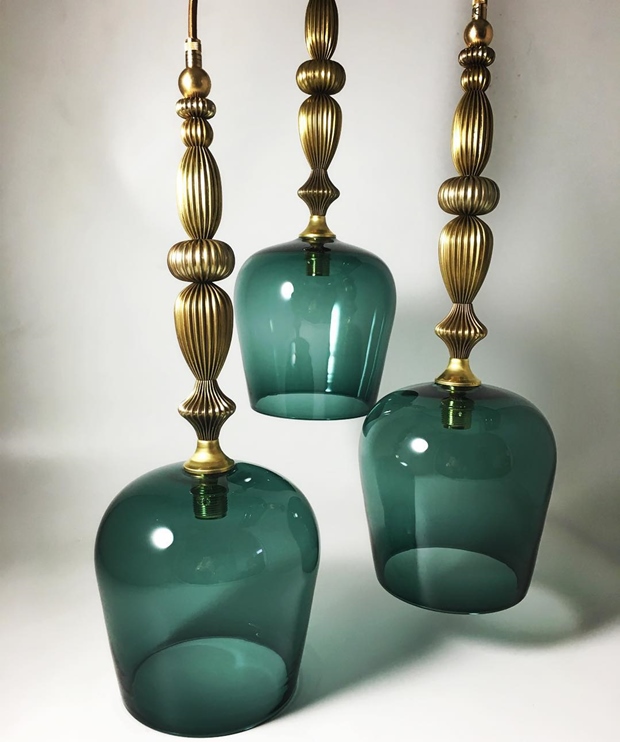
Flora Pendants by Rothschild & Bickers

Nip clutter in the bud and don't let it build up and control you. In my case, I have never been keen on ornaments but was still surprised to find out I still own way too many of those; they end up being begrudgingly cumbersome as space occupiers and dust collectors - not a good prospect when you live in an already-cluttered house and in the path of the dusty, desert-borne sirocco winds!

A cluster of Flora Pendants in Jade at Motel One München-Sendlinger Tor

I decided years ago that life is too short to be cumbersome and too precious to be cheap. Sometimes you need to carefully splurge on a select few investment pieces that will accompany you down the journey of life and beyond, passed down to the next generation. Quality pieces that do not necessarily shout out hefty price tag, antique heirlooms and vintage memorabilia but that spell out design, elegance, timelessness per se, and a certain uniqueness, in that 'upper' high street parable.

Twinkle, twinkle little light...

First for the cheerful and edible stuff (7 years later, I betcha!), I have happily found a box of designer coffee, upmarket English tea, and fancy sugar cubes neatly packed up. Those will come in handy, and needless to say sprinkle tea-time with a generous spoonful of English nostalgia.

Standing Pendants by Rothschild & Bickers

I'm still not done with my treasure finds, yet I have unwrapped some of what I consider my investment pieces (two of which were cheap as in even a cash-stranded student could afford those!):
  • a Mexican bedframe in repurposed vintage pine and custom-painted (bought from John Lewis before the retail store started losing its edge to the mainstream)
  • a pair of reproduction cast-iron book-ends (cast in original Victorian moulds, and purchased in Ironbridge, Shropshire, a good 20 years ago)
  • a French rococo gilded crystal chandelier, circa 1910 (a bit of a fancy purchase in relation to my budget at the time, from a specialist antiques shop on the Hale end of Altrincham, Cheshire) - yeah the posh end of town...
  • an original copy of Salome by Oscar Wilde, which I randomly came across in some charity shop in Didsbury Village, Manchester (cost me a fiver and at the time was already worth at least £80).

Steel Standing Pendants

Not all my finds were happy finds. I cringed at some of the clothing I had forgotten about (which will be heading the charity shop way soon enough!). I despaired about knick-knacks (presents from friends and family), books (Marketing for Dummies and Photoshop for Beginners type of books that shall not grace any shelves and thus remain tightly packed in boxes until disposed of via eBay).

Opulent Optic Pendants

Source: If you are seeking bespoke investment pieces rooted in European manufacturing, traditional handblown glass craftsmanship, and period-inspired pieces revisited through a resolutely clean and modern twist, Rothschild & Bickers is your port of call. The small English company has made it its speciality to turn the mod-con of lighting into an object of desire that will sit at home in antiques-furnished abodes, stately homes, modern environments... and retail outlets alike. Rothschild & Bickers lights will stand the test of time and fads and still spell out a statement steeped in history with a forward-thinking standpoint. No shadow of a doubt about this. My favourite pieces include the (1) Flora Pendants range, retailing at £370 (small) and £440 (large), and (4) the Standing Pendants range, retailing at £520. (2-3) The Flora range blossoms at Motel One München-Sendlinger Tor, Munich, Germany. (5) Bespoke Steel Standing Pendants, photography via Rothschild & Bickers' Instagram account. (6) The Opulent Optic range retails at £370. (7) The Vintage Light (see below picture, to the right) is a styled reinvention of the fringed mid-century affair found in your nan's sitting room and the jumble shop down the road... Attention please! No tired mustard velvet and no dusty chintz here: colours are sharp, the glass dome may be wiped clean with a damp sponge, and the light comes with a wispy fringe of your choice! Make mine the Satinwood Gold. The Vintage Light retails at £440. (8) Talk about customising that investment piece: over 90 flex types available! Photography via Rothschild & Bickers' Instagram account.

A fringe to frame that face
Flexes of your choosing

Investment Pieces for the Home is to become a regular Mirabelle feature. We'll review objects of desire that are set to last the distance and become heirloom pieces in their own right. God forbid, those items you might even profit from, should times get dire and your household require an instant cash injection. Further inspiration from Mirabelle's Pinterest board, Interior Design Delight.

30 Oct 2016

Bat Out of Hell!

Initially Mirabelle's wink to Halloween was to feature a 1952 photograph by talented French photographer Robert Doisneau (1912 -1994), entitled 'Porte de L'Enfer, boulevard de Clichy, Paris 9è arrondissement', L'Enfer meaning Hell/ Inferno. The caped policeman 'flying past' the toothy gothic monster was referred to as hirondelle (swallow) back in the day, in reference to the distinctive cape that policemen wore when out on the beat that made them look like swallows when dashing around.


As a fitting correlation to the Halloween theme, I was prone to view the swallow as a bat defying the gates of Hell; note the policeman's confident - almost defiant - demeanour. L'Enfer cabaret (now defunct) stood in the colourful world-famous artist quarter of Paris, Montmartre.


Taking a closer look at the famed photographer's portfolio, it is easy to feel transported to a world of the spooky and the bizarre and the occult, so I couldn't resist adding on a few more Doisneau pictures that coincidentally capture the Halloween spirit, turning the wink into a long glance. The monochrome shots add to the ambience. Now up to us to solve the mysteries or just go along with their imbued poetry...


Sources: (1) 'Porte de l'Enfer, boulevard de Clichy, Paris 9è arrondissement', photography by Robert Doisneau, 1952, via L'Agence Photo RMN Grand Palais (*). The print is showcased at Centre Pompidou, Paris. (2) Sepia postcard of the Montmartre district of Paris, featuring boulevard de Clichy (Le Ciel et l'Enfer) cabarets, via Pinterest, allegedly dating back to the turn of the 20th century. Both cabarets were avant-garde surrealist themed venues. Le Ciel (meaning Sky/ Heaven) was an artists cabaret with a loose angel theme attached to it, while its flamboyant gothic next-door neighbour L'Enfer (Hell/ Inferno) cabaret erred on the morbid and the macabre. Such like venues were popular in 1880s-1920s Paris. (3-6) Robert Doisneau, photography via Atelier Robert Doisneau. (3) 'Yves Corbassière dans sa voiture à carreaux' (Y.C. in his checkered car), Saint-Germain-des-Prés, Paris, 1948. (4) 'Stricte intimité' (Closest and dearest), Montrouge, 1945. (5) 'Une femme passe' (A lady walks by), Paris, 1945. (6) 'Le pendule' (The pendulum), 1945.

(*) RMN = Réunion Musées Nationaux
Related Posts Plugin for WordPress, Blogger...