Showing posts with label pattern. Show all posts

25 Nov 2017

The Art Déco Redesign of Saint-Quentin

It is high time Mirabelle paid its dues to a northern French Art Déco town which holds a special place in my heart: my hometown of Saint-Quentin! A born-and-bred saint-quentinoise, I spent my formative years there. I moved away for college before returning briefly home (for three years), and then onto the next leg of my personal journey, the UK.

Most of my family still lives in Saint-Quentin. My parents relocated to Corsica ten years ago and I followed suit from the UK approx. three years later. When my dad left Saint-Quentin, he left his heart behind - and probably even his soul. I left bits of myself behind and fragments of my heart too. Whether we acknowledge it or not, we all leave bits of ourselves behind whenever we up sticks.

Nouvelles Galeries, rue Saint-Jacques
ibid.
ibid.

We are ambivalent as to whether we should have moved away, whether we should have moved on with our lives. For my dad, this has proved virtually impossible after he was forced to sell our much-loved family home, a one-of-a-kind (unique) property whose elaborate construction and overall design he had been personally invested in every step of the way over the course of almost 35 years. A painstaking labour of love carved out of the best materials, using the best skillsets, that makes the house he lives in now a mockery (his words) if only in terms of architectural merit.

Mosaic ribbon (detail), rue de la Sous-Préfecture; another element of the façade is shown on pict. (13)

The irony of it all is that through our time in Saint-Quentin, none of us hardly took any photos of the town itself, none of us photographically recorded its beautiful, history-laden architectural heritage which was the background to our every day. A faux-pas which I reiterated in Manchester! So once again, I find myself reliant upon other people's photography in order to relate a part of my personal, intimate history.

Trade 'Commerce' medallion on a façade, rue de la Sellerie, carved out by French sculptor Raoul Josset

The moral of the story: do not take for granted the locale you live in. Pay attention to it, observe it, acknowledge it and immortalise it with your camera (or your paints and brushes or pencils).

Because this article just so happens to be a tale of ironies, the other irony is that while living in Saint-Quentin, we didn't pay much attention to its Art Déco architecture. We took note of the older (albeit rare) buildings that survived WWI ravages (and to a much lesser extent WWII ravages), namely the Basilique Saint-André (Basilica), Hôtel de Ville (Town Hall), Palais de Fervaques (tribunal) and theatre, all of which were extensively renovated post-war. Scattered vestiges here and there also survived the war. In actual fact, roughly 70% of Saint-Quentin was destroyed by the Great War.

Criée Municipale frontage, place Gaspard de Coligny

Now prepare for some home truths in this tribute:

Art Déco architecture was such an element of our daily lives - we bathed in it - that we found it too mundane and ordinary, to be worthy of any value. We didn't notice its merit, nor did we recognise it formally as a component of the internationally-celebrated design movement. We appreciated it only for what it was: an architectural style that characterised our town (and other northern towns and villages) and made it functional, rather than functional, innovative and eye-pleasing. We did not sing its praise. Rather, it just happened to be there, a mere landscape to our lives.

Brochure, via Calaméo

In retrospect, I wish I had paid attention. I hear you suggest that I could return to Saint-Quentin to soak it all in and capture it but nostalgia, and generally the memory of loved ones gone, times gone and a way of life gone, have ways to make you sea-sick. And this is the pain I have interiorised. Maybe after all, we shouldn't have gone in the first place. Just stayed put. But is this what life is about? Stay put? Deprive yourself of brand new adventures?

Buffet de la Gare, train station restaurant mosaic (detail)
Forged iron and bevelled glass door (detail), rue Voltaire

Now let us be clear. To label Saint-Quentin as strictly an Art Déco town (as modern-day historians tend to do) is a fallacy. It deprives it of its rich, long and checkered history: founded by the Romans, sacked and looted by the Francs (in 406), then by Atilla the Hun (in 450), and later by the Barbarians (in 531). Not to mention other charming visitors like the Spanish conquistadores and the Prussians. Saint-Quentin's strategic location as a gateway to northern and Eastern Europe, made it a geopolitical hotspot and a battlefield, as well as an intersection point between paganism and christiandom.

The Casino cinema, built 1929, a flamboyant landmark

The prevailing Art Déco style across our northern town reflects the fact that 3/4 of its pre-WWI buildings had been blitzed out by war. Thus no expenses were spared when reconstruction came about. This coincided with the flourishing movement of the time, Art Déco, using a variety of materials (brick, stone, slate, marble, granite, mosaics, stained glass, enamel, concrete, plaster, forged iron, stainless steel, bronze, brass, copper, lead, wood) and a palette of techniques that heralded the new and the bold while grounding it into a solid classical approach in terms of proportions, perspective, materials and general elegance. The constructions were made to last the distance in terms of both appeal and quality, not be demolished on a whim within a couple of generations.

Local architectural firms, as well as those from Paris, Lille or nearby, all delighted in the prospect of showcasing their know-how, and added quirky touches as they came up with residential, commercial, institutional and industrial premises, not to mention train stations, churches and war memorials, that lived up to their name, reputation and promises.

Art Déco translated the wave of post-war optimism into a movement. No solemnity to it, only a hymn to joy and oppulence meant to affect everyone positively, if only by way of a little architectural beautification, whatever came to play to perk up a nation raw from the horrors of the Great War.

Over several years, in certain cases to the dawn of WWII (or beyond for churches), the reconstruction of France and other war-torn nations was akin to a beehive of ingeniosity writing the book of 20th century design and paving the way for the mid-century modern of later years. Artisans and craftsmen were an integral part of the workforce, hence process. My great grandad, Joseph, a marine carpenter by trade, travelled all the way from Brittany to Saint-Quentin with his family in order to provide his sought-after skills to the building trade.

The Conservatoire Municipal (Music Academy) lobby area

After all, mass-consumerism hadn't quite cut its teeth into society just yet. France was still being built up out of wares that had been made in France! There was this fierce, strong sense of belonging and the Nation State. Personalisation, customisation and innovation played an important part in Art Déco craftsmanship. The result was an architectural equivalent of fashion haute couture or a quality off-the-peg piece, rather than ready-made, pre-assembled ensembles churned out on an industrial scale. Ironwork was hot off the local forge, not off Home Depot.

Decorative terracotta grapevine relief band, residential property, Champs-Elysées area?

All these elements fuse together into lessons in contemporary design and late neo-classicism that many a modern-day architect worth their salt should embrace rather than run from or deride. I cannot bear to think what our towns and cities would look like if they were being rebuilt today, under this post-industrial, post-craftsmanship styleless, paradigm of using cheap and cheerful one-size-fits-all Far-East imports that line up the shelves of DIY chain stores. I can all too painfully notice its ravages at a local level (in Corsica), the breeze block-plasterboard-PVC residential combos with their utterly charmless personality-devoid utilitarian Soviet finished look. Life is meant to be celebrated, not mourned, which is why Art Déco should make us thankful. Rejoice, people, rejoice!

Glass and metal front door, rue de la Sous-Préfecture; another element of the façade is shown on pict. (4)

Sources: Art Déco knows no blandness. Art Déco as a movement created bold, awe-inspiring, sculptural - even flamboyant - statements. Think the Chrysler Building! Made up of bold, aerodynamic, streamlined curves, abstract patterns and geometric florals and feathers, it is meant to be embraced from a distance and appreciated up close. A celebrated duo of form and function that epitomises good design and relishes both its clean lines and intricate vignettes and frescoes. Born just after WWI, the artistic and architectural movement swept across the world and span across the Roaring Twenties and Depression Era.

Front door (detail) of the Grande Poste (central post office)

(1-3) Construction of the Nouvelles Galeries retail store started in 1922, and the store opened to the public five years later. Despite the building having been disused for the last 50 years, it has nonetheless managed to keep visitors spellbound to this day. While awaiting an hypothetical renaissance, the site has found its vocation as an exhibition hall for... Art Déco exhibitions! (1) Photography by Julien Sarrazin, via On Teste Pour Vous en Picardie. (2) La folle expo d l'Art  Déco, photography via Art Déco de France. (3) Photography via the city of Saint-Quentin's official website. (4-5) L'Art Déco à Saint-Quentin, photography by Jean Triboulloy and Michèle Wojciechowski. (4) Mosaic ribbon (detail) fringing the façade of a much-photographed Art Déco maison bourgeoise residential property, located next to the sous-préfecture. See its panelled glass and ironwork door pict. (13). (5) 'Commerce' medallion on a façade, rue de la Sellerie, carved out by French sculptor Raoul Josset. Interestingly the prolific sculptor moved to the USA in order to pursue his craft under the Art Déco influence; he created larger-than-life statues in his adopted state of Texas. (6) Criée Municipale, unattributed photography via Nicole Boxberger. It features a concrete curved one-storey building that used to host the municipal fish market. I remember it operating until at least 20 years ago. Under the town hall's Art Déco preservation and renovation programme which provides incentives and professional advice to eligible property owners from both the public and private sectors, the Criée was renovated. Its lettering, which used to be a tomato red on cream, has now been given a flattering blue floral treatment that lends panache and a little relief to the signage. The neat Art Déco typeface is pure typographical delight! (7) Art Déco has taken centerstage in Saint-Quentin only recently, over the last 25 years. Prior to that, the movement might have been perceived as being still too recent in order to deserve acknowledgement and critical acclaim from local historians, the local authorities and the local population alike. The brochure 'Raconte-moi l'Art Déco à Saint-Quentin' was published by the Local Authority (Agglomération du Saint-Quentinois), and is available to read via Calaméo. (8-9) Photography by Pascal Stritt, featuring (8) the mosaic detail of the Buffet de la Gare (train station restaurant), and (9) the forged iron and bevelled glass door, rue Voltaire. (10) Inaugurated in 1929, the flamboyant Casino cinema and music-hall is flanked by two pilasters topped by carnival heads, Jean qui rit (the laughing John symbolises comedy) and Jean qui pleure (the weeping John symbolises tragedy). The heads used to spook me stiff every time I went past! (11) The Conservatoire Municipal (music academy) is a gem of Art Déco fusion, with its façade bearing a distinctive flemish style flanked by bow windows. (12-13) Photography by Sandra Cohen-Rose and Colin Rose, via Flickr. Their photography portfolio is a collection of (mostly) Art Déco architecture, including architectural artefacts (plaques, reliefs, friezes, etc.) from around the world. (12) Decorative terracotta grapevine relief band on the façade of a residential property believed to be in the vicinity of the Champs-Elysées municipal gardens. (13) Glass and metal front door, rue de la Sous-Préfecture. Cf. pict. (4) for another element of the façade. (14) Glass and metal front door detail of the imposing Grande Poste (central post office), located nearby the Basilica. Photography by MEL.A, via Instagram. René F. Delannoy was the architect (1929). The account features more Art Déco views of Saint-Quentin. (15) Photography by Pascal Stritt, of one of the tin plaques that decorate the bar of the Restaurant des Champs-Elysées, rue de Baudreuil. (16) The Art Déco movement is now celebrated every Spring in Saint-Quentin and neighbouring towns.

Tin plaque, Restaurant des Champs-Elysées, rue de Baudreuil

Further Resources:

A yearly celebration of Art Déco in Saint-Quentin

_________

* The acute accent on the letter 'e' of Art Déco is my deliberate attempt at translating the fact that the Art Déco movement originated from France. It derives its name from the Exposition Internationale des Arts Décoratifs et Industriels Modernes held in 1925 in Paris, an event which came to be known as a catalyst of the Art Déco movement.

* Last updated 12-Apr-2018.

15 Nov 2017

Bug Life

For a piece of visual entomology, look no further than Alex Wild Photography! Mirabelle has been following Alex's Twitter account for years now and this is one of my favourites: a Twitter perk that stands out from the Twitter mush!

There you get close with the bugs and once you magnify and get to their level, discover the beasts of engineering that they are: fascinating, awesome and pretty darn scary too!

Calliphora augur, Diamond Creek, Victoria, Australia

Myrmecia pyriformis, Yandoit, Victoria, Australia

Nesomyrmex wilda, Harlingen, Texas, USA

Nasute termite soldier, Yandoit, Victoria, Australia

Pogonomyrmex comanche, Red Rock, Texas, USA

Apis mellifera, Austin, Texas


The macro-photographic skillset of Texas-based American biologist Alex Wild plays its magic and his carefully-chosen
subjects are equally magical. The descriptives bear none of the generalist attributes that non-scientists like myself are guilty of using all too often when faced with unidentified small creatures: critters, bugs, insects, creepy-crawlies, flying things (ha-ha!) and other often-erroneous and somewhat disrespectful captions.

Here we dive deep into entomology territory, the taxa, order, genus, species and sub-species, and catch ourselves on a learning curve if we are serious enough about the views we entertain. This is how I found out, as a starting point, that myrmecology is the entomology branch related to ants.

When faced with the ingeniosity of life at its tiniest level, you cannot help but think about the Great Architect of the Universe and how none of this would have been possible without Him at the helm. Without politicising this post, I would venture the belief that atheists are deniers of God when you witness how the divine has engineered nature in a way that is humanely impossible to achieve.

Anastatus sp., Austin, Texas, USA

Ceratopogonidae forcipomyia, Cayó District, Belize

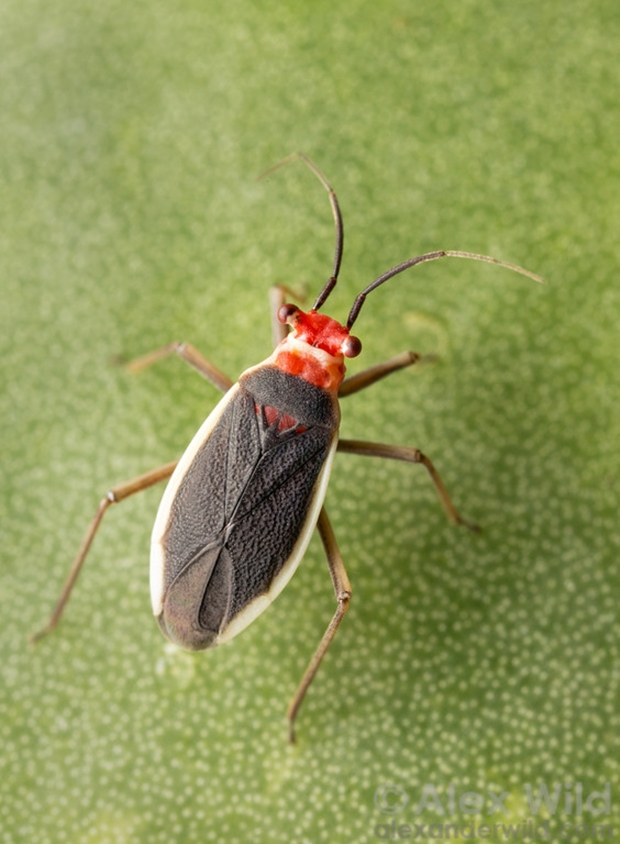
Hesperolabops gelastops, Austin Texas, USA

Tutelina elegans (male), Urbana, Illinois, USA

Chrysina lecontei, Huachuca Mountains, Arizona, USA
Tetragonisca angustula, Morretes, Paraná, Brazil

Alex Wild has managed to build a captive audience out of science proselytes like myself, and the macro-photographic journey amongst creatures of the tiny order is both captivating and humbling!

Source: All photography by Alex Wild Photography.

6 Nov 2017

Floral Sophisticates

You needn't be looking for beauty for it is all around you in the natural world if you care to notice and observe. Flowers have it in spades of enchantment... The art of the artist is to capture the beauty they notice but which might be going unnoticed by others, emphasise it and restitute it for it to be (finally) noticed, acknowledged and appreciated. Kate Scott is bewitched by the beauty of the floral kind and Mirabelle has too been spellbound by floral beauty for as long as I can remember.

Flower power has hit home! The curves, curls and swirls, the shades, hues and ombrés, the seemingly laser-cut petals, the detailing, the precision, the floral geometry, Fibonacci of sorts that ushers floral art into the sacred, the intricacies, fragility, ephemerality, the sophistication of flora at its paramount best that is bound to leave you speechless... All of this skillfully captured by Kate Scott. Welcome to the floral art world, a delicacy for the senses and an instant mood lift!

Gipsy, Dahlia (detail), by Kate Scott Studio
Grace, Dahlia (detail), by ibid.
Fleur, Ranunculus (detail), by ibid.
Blush, Ranunculus (detail), by ibid.
Frill Seeker, Hibiscus (detail), by Kate Scott Studio
Peaches, Roses (detail), by ibid.
Folly, Peony (detail), by ibid.
Amazon, Tulip (detail), by ibid.

"I have always found flowers bewitching. My aim as an artist is to capture the essence and soul of each bloom and present it in a way which cannot otherwise be readily seen. No camera is used in this process. Flowers are scanned at high resolution then digitally painted, pixel by pixel, capturing the tiniest of detail, often invisible to the naked eye. A single specimen which measures only a couple of inches across is transformed into a sensual landscape and in this way, each flower is reinvented and reborn. It is a painstaking process, often taking hundreds of hours to produce one large printed piece." - Kate Scott 

Source: All artwork digitalisation by Kate Scott Studio. Her exquisite limited edition flower prints are available to purchase directly from her online boutique. Printed on museum archival paper.

30 Sept 2017

Green with Envy

Rich Autumn colours of Burgundy and pomegranate reds, pumpkin orange, chocolate brown and aubergine purple are all well and good but when green ordinarily sends your heart aflutter, gives a spring to your step and takes nature indoors into a house party celebration of the bounties of life, there is simply no forsaking the colour green for a change of season.

There is not a more visual way to stamp personality onto a home than through wallcoverings and Style Libray is a worthy starting point. Now if green is your cup of green tea like it is mine, they have a sampled variegation of greens to explore at our leisure...

"Have nothing in your houses that you do not know to be useful or believe to be beautiful." - William Morris

'Cashmere Paisley' wallpaper by Sanderson

As the largest soft furnishings group in the UK, Style Library operates a portfolio of six British brands, two of which of iconic, heritage status Sanderson  and Morris & Co. Sanderson, established 1860 in Islington, London, by Arthur Sanderson, was awarded the Royal Warrant in 1923 and then again in 1955. Morris & Co. was established 1861 by famed textile designer, typographer, poet, philosopher and political theorist William Morris (1834-1896). Mr. Morris is associated with the Pre-Raphaelites and the English Arts & Crafts Movement. His wallpaper designs translate naturalism through the Aesthetic style.

The other brands under the Style Library umbrella are luxury wallcovering creator and archive curator Zoffany, colour trend-setter Harlequin, Scandi-inspired and Mr. Fox prints Scion, and contemporary wallpaper designer Anthology.

'Verdure' fabric by Zoffany
'Strawberry Thief' wallpaper by Morris & Co.
'Caverley' fabric by Sanderson

Sources: (1-5) Style Library. (1) Rest assured: this frilly foliage is no fuddy-duddy! The 'Cashmere Paisley' wallpaper (colourway code: DART21680) is part of the aptly-named Art of the Garden botanical wallpaper collection by Sanderson. A fresh and dainty paisley design in a sage colourway that is more neutral than feminine, Cashmere Paisley will light up a North-facing room like no other. Pair with white-painted woodwork in satin finish and a quality sisal floorcovering to add warm texture. To make the room shine boldly, introduce a statement Murano glass floral chandelier in a contrasting coloured glass of pink or blue. Without a shadow of a doubt, that North-facing room of yours will start enjoying the bright side of life!

(2) For those of us who seek a heritage linen fabric that does not look like it belongs in the National Trust, 'Verdure' (colourway code ZAMW320465) by Zoffany is worth considering. Based on a late 17th century painted cloth, Verdure will take your windows on a wondrous wander across pastoral lands. With the church in the background and tea-time beckoning, the only question on your mind will be: 'More tea, vicar?' The design has a modern (Art Nouveau) quality to it and the teal green oscillates between turquoise and slate.

Green paint shades, top row from left: Misty Mint, Queen Anne Green Light and Green Shoot (all three by Sanderson); bottom row from left: Lime Cloud, Green Almond (both by Sanderson), and Fennel (by Zoffany).


(3) As an action-packed heritage wallpaper for a single feature wall contrasting with the other walls in a plain cream, 'Strawberry Thief' (colourway code DMCR216477) by Morris & Co. beckons. As the pièce de résistance to your dining room, it will be your conversation piece as soon as guests arrive and companion piece once they are gone. Originally a cotton fabric design, it was registered in 1883. One of the most popular Morris fabrics, it is now available as a wallcovering.

(4) For a bird theme that is less prominent than Strawberry Thief, combined with only a few hints of green supported by pops of floral pink on a mustard canvas (referred to here as Chinese Yellow), the 'Caverley' fabric (colourway DCAVCA202) by Sanderson does the trick. It resmbles a tapestry, with a Chinoiserie influence although the design is described as being 'typically English in style' despite its exoticity. It is based upon an early 19th century hand-block print.

(5) Green paint collage by Mirabelle. Paint shades, top row from left: Misty Mint, Queen Anne Green Light and Green Shoot (all three by Sanderson); bottom row from left: Lime Cloud, Green Almond (both by Sanderson), and Fennel (by Zoffany).

10 Aug 2017

Fresh, Crisp and Leafy

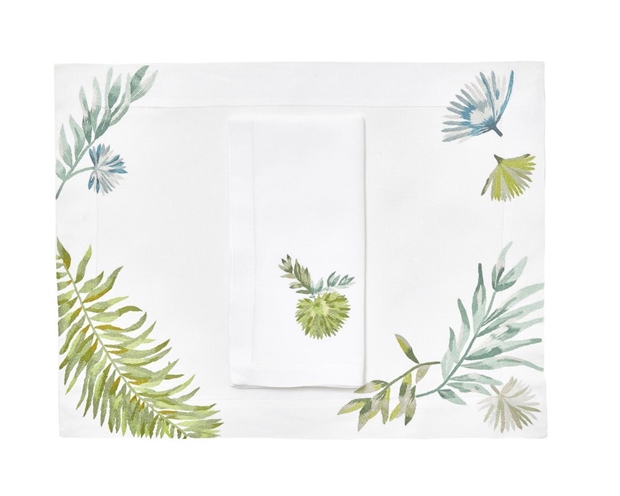
Mirabelle never imagined for one second that placemat and napkin sets would catch her eye, get her excited and get an article in the process with adjectives like fresh and crisp and leafy... When was the last time such adjectives were used in unison to describe those little accents of table linen?

Maybe placemats used to leave you indifferent too... until now! Because you and I hadn't yet crossed paths with the French luxury linen company D. Porthault, that's why!

Need a little convincing? Surely not as I can see you gaze admiratively at the exquisite artistic sets below... And since you're asking, Tempête Tropicale is my favourite. How about yours?

Tempête Tropicale
Anagramme Lilac
Mariage
Papyrus
Lilas Blue
Feuilles d'Olivier Soft Green

The sets represent only a tiny sample of D. Porthault linen collections: you really need to check those out for yourselves!

Always ahead of the game, The Glam Pad has just announced the imminent release of D. Porthault: The Art of Luxury Linens, a coffee table book showcasing those eponymous colour-rich home collection textiles, sure to brighten up our bedside cabinets as we move towards shorter days and longer nights. With such a book to hand, we'll naturally want to stay tucked up in bed just a little longer, flicking through the pages, enjoying the visual treats and redesigning our abodes! Sweet dreams and happy home projects to you!

Available to purchase from Gibbs Smith

10 Jul 2017

Melania Trumps Fashion

Ladies and gents, when was the last time we took such an interest in a First Lady's attire? Jackie Kennedy set a fashion precedent back in her day for sure but her successors did not follow suit, either by choice or disregard to becoming a style ambassador. Fashion became irrelevant, it faded into backgrounds of tame wallflowers and obligatory tea parties, sugared out and watered down in a self-imposed protocole of blandness and drabness, epitomised by a middle-aged dress attitude and safe colours of creams, magnolias and other sickly pastels worn conservatively in designs unchanged and unchallenged, the sort that typifies English royalty of a certain age.

Dress by Hervé Pierre and coat by Bottega Veneta, Hamburg City Hall, Germany

I mean, who could have gushed over Barbara Bush's granny-like attire, or even Nancy Reagan's, one blue rinse and two carat diamonds up from your grandma's Sunday best. I will not even talk about Laura Bush because we are then in garden society board meeting territory. And I doubt Michelle Obama ever transited from her office job to FLOTUS in all honesty.

Scuba-knit découpage dress by Delpozo, Copernicus Science Center, Warsaw, Poland

Now a soft revolution is taking place in the closets. Melania is a fashion ambassador that fashion designer dreams are made of. Apart from the likes of Marc Jacobs, Tom Ford and Zac Posen who adamantly chose to shun her at their peril. Beware because wherever Melania goes, the garments she wore that day sell out like hot cakes! A boon for designers like Dolce & Gabbana who are making sure the world knows how proud they are to dress the First Lady who to them personifies the #DGWoman par excellence!

Dolce & Gabbana floral coat, G7 First Ladies visit, Catania, Italy

Aside from certain high-ticket accessories (her ethical fashion faux-pas Hermès crocodile-skin Birkin handbag and her $51,500 D&G floral coat), Melania's dress attire generally does not exceed the $2,100-$3,000 bracket, a snip by billionaire standards - and only a little extravagant by middle-class standards: either mummy gets her designer dress or the family takes a two-week vacation in the sun.

“FL Melania in a $51,500 Dolce & Gabbana coat. The price tag will trigger liberals, but -- too bad! The Trump family epitomizes the American Dream.” - TrumpAdmin.daily.updates

Scuba-knit découpage dress by Delpozo, Warsaw, Poland

Talking of crocodile skin, every Melania fan who supports her style but refuses to compromise on their animal advocacy values at the same time, dreams that Melania will one day soon enough add another feather of compassion in her cap by wearing fur and animal skin no more. Well, fret not because Pamela Anderson took up the challenge earlier this year by sending Melania a fur-free coat from ethical faux-fur Russian company Only Me that did not go unnoticed. Melania pledged to ditch the fur, while this could be the start of a beautiful friendship for those two ladies, you never know!

“Amid all the mania at the inauguration, you looked stunning in an outfit by Ralph Lauren—one of many fur-free designers.  I am so happy that you chose not to wear fur! As first lady, you will help set style trends, and by remaining compassionate with your choices, you will warm the hearts of many.” - Pamela Anderson in a letter to Melania Trump

We never expected a lady like Melania to fade away in a background of magnolia wallflowers. She has the demure elegance, the grace, the poise, the features, the shape, the beauty all rolled into divine proportions to carry off much more than her predecessors' safe shades and patterns. She knows how to hold herself, carry herself and project a statement of sensibility and confidence. So far as the FLOTUS, she has worn items by couture houses as diverse as Ralph Lauren (on inauguration day) and Hervé Pierre (on inauguration night), Dolce & Gabbana, Emilio Pucci, Delpozo, Diane Von Furstenberg, Michael Kors, Bottega Veneta, and high-heel footwear maestros Manolo Blahnik and Christian Louboutin. Rest assured that the list will have reached stellar heights by the end of the Trump presidency.

Floral-print crêpe gown by Emilio Pucci, The White House, Washington DC

On an interview last year with Harper's Bazaar, Melania was asked which First Lady she admired most and found most inspirational in terms of style and was prompted with the names of Jackie and Nancy. She brushed those away in a snip and replied emphatically that her fellow fashion model Carla Bruni-Sarkozy (former French First Lady) was her inspiration. What a statement! Why fade away between the teapot and the Bourbon biscuit when you can carry on being what you were made famous for: an attractive, confident, head-turning fashion icon!

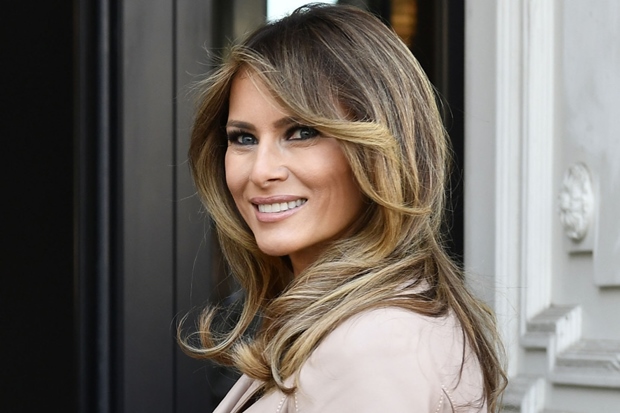
First Lady Melania Trump, wearing a Dolce & Gabbana outfit, official White House portrait

Yet Melania goes beyond the superficiality of fashion. She carefully chooses her dresses to bring a message, like her Delpozo scuba-knit dress she wore on her visit to Poland and whose pop art colours carry a strong nationalistic message (they reflect the colours worn by the Polish military). Prior to her husband being elected, she also wore a vibrant pink Gucci pussy-bow blouse at the second presidential TV debates, following her husband's notorious 'Grab them by the pussy' line. If this was not her tongue-in-cheek way of diffusing a hyped-up situation, I wonder what was.

Gucci pussy-bow blouse, second presidential TV debates (October 2016)

Melania is proving that a former fashion model is not a clothes horse. She has come a long way since inauguration day where her reserve, nervousness and slight reticence at times were palpable, especially under the magnified anti-Trump media scrutiny. Melania is blossoming out right before our very eyes as a First Lady who has managed to incorporate her love of fashion into her political agenda. She is a Trump powerhouse all to herself and will be remembered in her own right by bringing more than just fashion personality (back) into the political arena.

Sharp and crisp on her way to Bedminster NJ! 

We can thank Melania for the fact that she is putting feminity back into both the fashion and political agendas. She makes a woman proud to be a woman once again. She shows us that you can be in your mid-forties and still be and look relevant, dapper and (so be said) a smouldering sex bomb. And with that, Melania slaps feminism in the face: no you shouldn't be sloppy in looks and attitudes in order to prove yourself to the world. Feminity is to be celebrated and embraced, not diminished and ridiculed!

She's a woman, a mother, a wife and a lady too! (pict source)

You watch my words: by empowering women through their reaffirmed graceful feminity and the values she stands for, Melania will come to be remembered as the best FLOTUS ever. The irony of it all is that she wasn't even born in the US and yet she incarnates American values more than her predecessors, some of whom harboured a strong anti-American stance (anti-prosperity, anti-ambition). Overall Melania is proving that being of foreign origin and having an accent should not prevent you from rising to the top - with grace. When it comes to the improbable marriage of politics and fashion, you seek a complimentarity of style between the two and Melania struck the balance effortlessly.  

I might not be American and not approve each and every one of her fashion choices but Melania sure is my First Lady.

@pamfoundation

More of Melania on Instagram: @trumpadmin.daily.updates ° @flotus ° @theofficialmelaniatrump ° @realdonaldtrump ° @stefanogabbana °
Related Posts Plugin for WordPress, Blogger...