Showing posts with label Flickr. Show all posts

25 Nov 2017

The Art Déco Redesign of Saint-Quentin

It is high time Mirabelle paid its dues to a northern French Art Déco town which holds a special place in my heart: my hometown of Saint-Quentin! A born-and-bred saint-quentinoise, I spent my formative years there. I moved away for college before returning briefly home (for three years), and then onto the next leg of my personal journey, the UK.

Most of my family still lives in Saint-Quentin. My parents relocated to Corsica ten years ago and I followed suit from the UK approx. three years later. When my dad left Saint-Quentin, he left his heart behind - and probably even his soul. I left bits of myself behind and fragments of my heart too. Whether we acknowledge it or not, we all leave bits of ourselves behind whenever we up sticks.

Nouvelles Galeries, rue Saint-Jacques
ibid.
ibid.

We are ambivalent as to whether we should have moved away, whether we should have moved on with our lives. For my dad, this has proved virtually impossible after he was forced to sell our much-loved family home, a one-of-a-kind (unique) property whose elaborate construction and overall design he had been personally invested in every step of the way over the course of almost 35 years. A painstaking labour of love carved out of the best materials, using the best skillsets, that makes the house he lives in now a mockery (his words) if only in terms of architectural merit.

Mosaic ribbon (detail), rue de la Sous-Préfecture; another element of the façade is shown on pict. (13)

The irony of it all is that through our time in Saint-Quentin, none of us hardly took any photos of the town itself, none of us photographically recorded its beautiful, history-laden architectural heritage which was the background to our every day. A faux-pas which I reiterated in Manchester! So once again, I find myself reliant upon other people's photography in order to relate a part of my personal, intimate history.

Trade 'Commerce' medallion on a façade, rue de la Sellerie, carved out by French sculptor Raoul Josset

The moral of the story: do not take for granted the locale you live in. Pay attention to it, observe it, acknowledge it and immortalise it with your camera (or your paints and brushes or pencils).

Because this article just so happens to be a tale of ironies, the other irony is that while living in Saint-Quentin, we didn't pay much attention to its Art Déco architecture. We took note of the older (albeit rare) buildings that survived WWI ravages (and to a much lesser extent WWII ravages), namely the Basilique Saint-André (Basilica), Hôtel de Ville (Town Hall), Palais de Fervaques (tribunal) and theatre, all of which were extensively renovated post-war. Scattered vestiges here and there also survived the war. In actual fact, roughly 70% of Saint-Quentin was destroyed by the Great War.

Criée Municipale frontage, place Gaspard de Coligny

Now prepare for some home truths in this tribute:

Art Déco architecture was such an element of our daily lives - we bathed in it - that we found it too mundane and ordinary, to be worthy of any value. We didn't notice its merit, nor did we recognise it formally as a component of the internationally-celebrated design movement. We appreciated it only for what it was: an architectural style that characterised our town (and other northern towns and villages) and made it functional, rather than functional, innovative and eye-pleasing. We did not sing its praise. Rather, it just happened to be there, a mere landscape to our lives.

Brochure, via Calaméo

In retrospect, I wish I had paid attention. I hear you suggest that I could return to Saint-Quentin to soak it all in and capture it but nostalgia, and generally the memory of loved ones gone, times gone and a way of life gone, have ways to make you sea-sick. And this is the pain I have interiorised. Maybe after all, we shouldn't have gone in the first place. Just stayed put. But is this what life is about? Stay put? Deprive yourself of brand new adventures?

Buffet de la Gare, train station restaurant mosaic (detail)
Forged iron and bevelled glass door (detail), rue Voltaire

Now let us be clear. To label Saint-Quentin as strictly an Art Déco town (as modern-day historians tend to do) is a fallacy. It deprives it of its rich, long and checkered history: founded by the Romans, sacked and looted by the Francs (in 406), then by Atilla the Hun (in 450), and later by the Barbarians (in 531). Not to mention other charming visitors like the Spanish conquistadores and the Prussians. Saint-Quentin's strategic location as a gateway to northern and Eastern Europe, made it a geopolitical hotspot and a battlefield, as well as an intersection point between paganism and christiandom.

The Casino cinema, built 1929, a flamboyant landmark

The prevailing Art Déco style across our northern town reflects the fact that 3/4 of its pre-WWI buildings had been blitzed out by war. Thus no expenses were spared when reconstruction came about. This coincided with the flourishing movement of the time, Art Déco, using a variety of materials (brick, stone, slate, marble, granite, mosaics, stained glass, enamel, concrete, plaster, forged iron, stainless steel, bronze, brass, copper, lead, wood) and a palette of techniques that heralded the new and the bold while grounding it into a solid classical approach in terms of proportions, perspective, materials and general elegance. The constructions were made to last the distance in terms of both appeal and quality, not be demolished on a whim within a couple of generations.

Local architectural firms, as well as those from Paris, Lille or nearby, all delighted in the prospect of showcasing their know-how, and added quirky touches as they came up with residential, commercial, institutional and industrial premises, not to mention train stations, churches and war memorials, that lived up to their name, reputation and promises.

Art Déco translated the wave of post-war optimism into a movement. No solemnity to it, only a hymn to joy and oppulence meant to affect everyone positively, if only by way of a little architectural beautification, whatever came to play to perk up a nation raw from the horrors of the Great War.

Over several years, in certain cases to the dawn of WWII (or beyond for churches), the reconstruction of France and other war-torn nations was akin to a beehive of ingeniosity writing the book of 20th century design and paving the way for the mid-century modern of later years. Artisans and craftsmen were an integral part of the workforce, hence process. My great grandad, Joseph, a marine carpenter by trade, travelled all the way from Brittany to Saint-Quentin with his family in order to provide his sought-after skills to the building trade.

The Conservatoire Municipal (Music Academy) lobby area

After all, mass-consumerism hadn't quite cut its teeth into society just yet. France was still being built up out of wares that had been made in France! There was this fierce, strong sense of belonging and the Nation State. Personalisation, customisation and innovation played an important part in Art Déco craftsmanship. The result was an architectural equivalent of fashion haute couture or a quality off-the-peg piece, rather than ready-made, pre-assembled ensembles churned out on an industrial scale. Ironwork was hot off the local forge, not off Home Depot.

Decorative terracotta grapevine relief band, residential property, Champs-Elysées area?

All these elements fuse together into lessons in contemporary design and late neo-classicism that many a modern-day architect worth their salt should embrace rather than run from or deride. I cannot bear to think what our towns and cities would look like if they were being rebuilt today, under this post-industrial, post-craftsmanship styleless, paradigm of using cheap and cheerful one-size-fits-all Far-East imports that line up the shelves of DIY chain stores. I can all too painfully notice its ravages at a local level (in Corsica), the breeze block-plasterboard-PVC residential combos with their utterly charmless personality-devoid utilitarian Soviet finished look. Life is meant to be celebrated, not mourned, which is why Art Déco should make us thankful. Rejoice, people, rejoice!

Glass and metal front door, rue de la Sous-Préfecture; another element of the façade is shown on pict. (4)

Sources: Art Déco knows no blandness. Art Déco as a movement created bold, awe-inspiring, sculptural - even flamboyant - statements. Think the Chrysler Building! Made up of bold, aerodynamic, streamlined curves, abstract patterns and geometric florals and feathers, it is meant to be embraced from a distance and appreciated up close. A celebrated duo of form and function that epitomises good design and relishes both its clean lines and intricate vignettes and frescoes. Born just after WWI, the artistic and architectural movement swept across the world and span across the Roaring Twenties and Depression Era.

Front door (detail) of the Grande Poste (central post office)

(1-3) Construction of the Nouvelles Galeries retail store started in 1922, and the store opened to the public five years later. Despite the building having been disused for the last 50 years, it has nonetheless managed to keep visitors spellbound to this day. While awaiting an hypothetical renaissance, the site has found its vocation as an exhibition hall for... Art Déco exhibitions! (1) Photography by Julien Sarrazin, via On Teste Pour Vous en Picardie. (2) La folle expo d l'Art  Déco, photography via Art Déco de France. (3) Photography via the city of Saint-Quentin's official website. (4-5) L'Art Déco à Saint-Quentin, photography by Jean Triboulloy and Michèle Wojciechowski. (4) Mosaic ribbon (detail) fringing the façade of a much-photographed Art Déco maison bourgeoise residential property, located next to the sous-préfecture. See its panelled glass and ironwork door pict. (13). (5) 'Commerce' medallion on a façade, rue de la Sellerie, carved out by French sculptor Raoul Josset. Interestingly the prolific sculptor moved to the USA in order to pursue his craft under the Art Déco influence; he created larger-than-life statues in his adopted state of Texas. (6) Criée Municipale, unattributed photography via Nicole Boxberger. It features a concrete curved one-storey building that used to host the municipal fish market. I remember it operating until at least 20 years ago. Under the town hall's Art Déco preservation and renovation programme which provides incentives and professional advice to eligible property owners from both the public and private sectors, the Criée was renovated. Its lettering, which used to be a tomato red on cream, has now been given a flattering blue floral treatment that lends panache and a little relief to the signage. The neat Art Déco typeface is pure typographical delight! (7) Art Déco has taken centerstage in Saint-Quentin only recently, over the last 25 years. Prior to that, the movement might have been perceived as being still too recent in order to deserve acknowledgement and critical acclaim from local historians, the local authorities and the local population alike. The brochure 'Raconte-moi l'Art Déco à Saint-Quentin' was published by the Local Authority (Agglomération du Saint-Quentinois), and is available to read via Calaméo. (8-9) Photography by Pascal Stritt, featuring (8) the mosaic detail of the Buffet de la Gare (train station restaurant), and (9) the forged iron and bevelled glass door, rue Voltaire. (10) Inaugurated in 1929, the flamboyant Casino cinema and music-hall is flanked by two pilasters topped by carnival heads, Jean qui rit (the laughing John symbolises comedy) and Jean qui pleure (the weeping John symbolises tragedy). The heads used to spook me stiff every time I went past! (11) The Conservatoire Municipal (music academy) is a gem of Art Déco fusion, with its façade bearing a distinctive flemish style flanked by bow windows. (12-13) Photography by Sandra Cohen-Rose and Colin Rose, via Flickr. Their photography portfolio is a collection of (mostly) Art Déco architecture, including architectural artefacts (plaques, reliefs, friezes, etc.) from around the world. (12) Decorative terracotta grapevine relief band on the façade of a residential property believed to be in the vicinity of the Champs-Elysées municipal gardens. (13) Glass and metal front door, rue de la Sous-Préfecture. Cf. pict. (4) for another element of the façade. (14) Glass and metal front door detail of the imposing Grande Poste (central post office), located nearby the Basilica. Photography by MEL.A, via Instagram. René F. Delannoy was the architect (1929). The account features more Art Déco views of Saint-Quentin. (15) Photography by Pascal Stritt, of one of the tin plaques that decorate the bar of the Restaurant des Champs-Elysées, rue de Baudreuil. (16) The Art Déco movement is now celebrated every Spring in Saint-Quentin and neighbouring towns.

Tin plaque, Restaurant des Champs-Elysées, rue de Baudreuil

Further Resources:

A yearly celebration of Art Déco in Saint-Quentin

_________

* The acute accent on the letter 'e' of Art Déco is my deliberate attempt at translating the fact that the Art Déco movement originated from France. It derives its name from the Exposition Internationale des Arts Décoratifs et Industriels Modernes held in 1925 in Paris, an event which came to be known as a catalyst of the Art Déco movement.

* Last updated 12-Apr-2018.

11 Aug 2015

Tiny Housing, Grand Living: Orii di Corsica

Welcome to our brand new series, Tiny Housing, Grand Living. Herein Mirabelle explores compact living habitat under all its guises, spanning climates, cultures and timelines. I am starting off with a bang and a WOW! of wonder, with the integration of tafoni (honeycombed rock surfaces) into the built environment, with whimsical faerical results! Just follow me down the southern part of the Mediterranean island of Corsica.

Those under-rock troglodyte shelters are called Orii in Corsican (Oriu, singular). They look like they might have - either directly or coincidentally - influenced  fantasy authors (and graphic artists!), and one would be forgiven for thinking Tolkien and The Smurfs Village as they tread the smooth rockfaces and climb the sea-salt-polished boulders surrounding those enchanted mushroom-shaped dwellings. The shelters are perfect examples of a harmonious integration of nature into human habitat.

Originally used as shelters in prehistoric times (as far back as 7,000-10,000 BC), those peculiar ground-level caves were later rendered more habitable by nomadic shepherds who erected dry-stone walls to close off openings. The shelters were also used as granaries. Oriu di Grossetto (pict 1-2) depicts this fascinating contrast between the smooth mushroom-like cap and its weathered, hollowed basis. Meanwhile Oriu di Canni (pict 4-6), with its pointed spire-like structure, resembles a chapel. This article being only a synopsis, many more Orii of note are to be contemplated at Ma Corse!


Sources: (1) Double Oriu di Grossettu and (2) Arche du Chaos de Grussettu (Grossetto Tafoni Arch), photography by Corse Sauvage, via Flickr (18-Jan-2012). Further details (in French) from their informative website, Blog Corse Sauvage. (3) Oriu de Caldarello, photography by Ma Corse (Jean-Marie Vergès). Further details (in French) from their comprehensive Orii section. (4) Oriu di Canni, photography by Christian Comiti, via Flickr. (5) Oriu di Canni, photography via Perierga (article in Greek). (6) Oriu di Canni, photography by Loïc Colonna. (7) A tafoni close-up (for reference only): Tafoni Sandstone Rock, from El Corte de Madera Park, San Mateo County, California, photography by randomtruth, via Flickr. "Tafoni are small cave-like features found in granular rock such as sandstone, granite, and sandy-limestone with rounded entrances and smooth concave walls, often connected, adjacent, and/or networked. They often occur in groups that can riddle a hillside, cliff, or other rock formation. They can be found in all climate types, but are most abundant in intertidal areas and semi-arid and arid deserts. Currently favored explanations controlling their formation include salt weathering, differential cementation, structural variation in permeability, wetting-drying, and freezing-thawing cycles, variability in lithology, case hardening and core softening, and/or micro-climate changes and variation (i.e. moisture availability). Tafoni have also been called fretting, stonelace, stone lattice, honeycomb weathering, and alveolar weathering." (source: Wikipedia).

14 Jul 2015

The Tile Files: Mosaics

Welcome to Mirabelle's monthly design series, The Tile Files. So far, our celebration of enduring tile design has taken us to the south of France (Tomettes), Portugal and Spain (Azulejos), and finally north of the old continent, to The Netherlands (Delftware). This has been quite a journey of stylish discoveries!

The Cul-de-Four Mosaic, Notre-Dame de la Garde Basilica (Marseille, France)

For this month's article, we need to delve deep into the arcana of Antiquities - to the second half of the 3rd Millenium BC - in order to track back our very first Mosaics. The decorative impact of those versatile and hard-wearing tile pieces belies no diminutive potentiality! In other words, the face of Antiquity would be disfigured if stripped off them! And it appears that from Empire to technique, Byzantine rules the finesse of the art!

Mosaic tiles (Tesserae) owe their perennial popularity to ceramic (clay that is glazed or unglazed). However, earlier mosaics referred to roughly cubic, terracotta brick, cut-stone (marble, limestone, granite or onyx) or cut-glass tiles, of irregular finish. Mosaics were sometimes made out of other materials such as natural pebbles, seashells, gemstones, precious stones, or ivory fragments.

Mosaic, c.200-100BC, discovered in 1993 during the construction of the new Alexandria Library, Egypt

Mosaics are assembled together with many more in order to pave a floor, a ceiling or a wall. Their small size enables them to cover curved and/ or uneven surfaces like columns or basins. Yet mosaics do not only lend themselves to the practicality of surface covering, they also hold a high ornamental value. To do so, they are combined together according to a specific colour pattern in order to create a repeated decorative motif (tessellation) that will define a border, or create a figurine or landscape element that will be part of a 'bigger picture', a mural, medallion, or bas-relief. As mosaics tell a story, they may even incorporate a name, a date, a motto, a sacred text, or a few descriptive words and other symbology.

Manufactured processes include gold glass, that is produced according to the Byzantine mosaic technique. The latter is applied to stone, gemstone, ceramic, seashell or glass, and brings together irregularly-shaped and handcut mosaic pieces of different geometric shapes that follow the artwork lines. Stone Glass Byzantine Mosaic murals are either made out of Smalti (hand-poured and hand-cut opaque glass) or manufactured glass tiles (of uniform shape and size). Both types of glass may be cut into irregular shapes for Byzantine mosaic.

Parque Güell, Sala Hipstila (Barcelona, Spain)

Mosaics have been precious visual story-tellers, not only to archaeologists, historians, anthropologists and ethnologists, but to anyone appreciative of their testimonial accounts, as they document passages of history, capture rites of passage or moments of daily life. Through their iconographic representations, those murals have contributed to relate the history of ancient civilisations, and the making of humanity.

The ancient decorative art of mosaics has transposed well into the present day, owing to their durability, which results from their individual compact size. This confers them that extra strength, and a certain fluidity of movement (under the duress of substrate shifts) when combined with other tesserae, making them less prone to breakage and cracks. To that effect, let's note the well-preserved three-millennia old cone mosaic courtyard (made out of polychrome terracotta cones), from the ancient Sumerian city of Uruk, and the glazed brick mosaics of the Ishtar Gate of Babylon (ca. 575 BC).

The Basilica of San Vitale (Ravenna, Italy)

More recent mosaic artwork is found in the ancient city of Ravenna (Italy), former last capital of the Western Roman Empire (5th Century AD) and headquarters of Theodoric's Ostrogothic Kingdom. The Basilica of San Vitale is part of an ensemble of Early Christian Monuments of Ravenna, described as being one of the most important examples of early Christian Byzantine art in western Europe, especially noted for its remarkable mosaics. The monument is inscribed on the UNESCO World Heritage List.

Mosaics have remained popular to the present day. The specs and technique have overall remained the same, despite being updated to fit mass-production criteria. The use of the cheaper vitreous glass (i.e. cast glass), mirror, ceramic materials with or without photoluminescent effects, all cater for mass-market fads. Other substrates include aluminium or wood. New effects are achieved thanks to a wider range of geometrical shapes. Cast or hand-cut options are available, according to the finished look sought out (sleek and modern or artisan). The pre-assembled (mesh-backed) mosaic sheets have streamlined the tiling process considerably.

Inspiration Green

Mosaics not only transcend the timeline from Antiquity to the present day, but also faith, creed and cultures, as their popularity, harked back from the cradles of civilisation of the Middle East (Mesopotamia) and the Mediterranean basin (Ancient Greece and Roman Empire), has since encompassed the whole world, to decorate sacred buildings, public places, and private residences alike.

In the course of the 20th century, mosaic popularity has been illustrated all the way from major design projects (the mosaic-inspired pique-assiette technique by Antoni Gaudí in Barcelona's Parque Güell springs to mind), to the more 'mundane' panels that take pride of place in commercial or domestic kitchens or spas. Meanwhile a tile company by the name of New Ravenna will - if only by name association - ensure that the mosaic grandeur of Ravenna remains in the collective psyche, and not only so... Countless other tile companies have too capitalised upon the versatility and durability of mosaics, Porcelanosa, Agape Tile, or Original Style, to name but a few.

'Jacqueline Vine' by Sara Baldwin for New Ravenna Mosaics

This article has only scratched the surface of tesserae. You might wish to scratch it a little deeper and unveil new treasures. A quick browse through the 1000+ eclectic mosaic collections from The Metropolitan Museum of Art will reveal more about mosaic versatility. Meanwhile Agape Tile has an interesting potted history section on Ceramic Tiles, and so does Designboom.

In next month's episode of the Tile Files, we will be gazing at the wondrous world of Majolica, in all its Florentine grace and Victoriana, and unfold more visual treasures along the way! Be there or be square!

'Avila' by Paul Schatz for New Ravenna Mosaics

Sources: (1) 'Mosaïque du Cul-de-Four de l'Abside', detailed iridescent Byzantine mosaic in the apse of Notre-Dame de la Garde Basilica, Marseille France. Photography by Robert Valette, via Wikipedia. More from Basilique Notre Dame de la Garde. The Basilica stands out in its hilltop Neo-Byzantine grace, that so befits the muted exoticism that exudes from its hometown of Marseille, known as the doorway to the Orient (la porte de l'Orient). Despite the church edifice dating back to 1864, the religious history of the place originates back to 1214, where a chapel once stood. (2) An antique advertisement for His Master's Voice or Tickle's ancestor? Mosaic floor depicting a dog and a knocked-over gold vessel, via Urge to Create. The c.200-100BC mosaic was discovered in 1993 during the construction of the new Alexandria Library, Egypt. It now sits in the Greco-Roman Museum in Alexandria. The tiny size of the tesserae (only 1-2mm across), allows great detailing and a painting-like effect. The technique was known in Antiquity as opus vermiculatum (‘worm-like work’). The photo originates from a book by Susan Walker and Peter Higgs, Cleopatra of Egypt. From History to Myth, Princeton University Press (2001). (3) Sala Hipstila, Parque Güell, Barcelona Spain, via Europaen Fotos. (4) id., via Park Güell. (5) 'Interior of San Vitale' (Ravenna, Italy), photography by Lawrence OP, via Flickr (July 2013). The Basilica of San Vitale is a jewel of early Christian art, featuring rich mosaic frescoes. The Mausoleum of Galla Placidia is equally sumptuous. More from Ravenna, Turismo e Cultura (Ravenna's official tourism website). (6) Cob bathroom, via Inspiration Green. (7) 'Jacqueline Vine', a jewel glass waterjet mosaic shown in 'Amethyst', part of the Silk Road Collection by Sara Baldwin for New Ravenna Mosaics. (8) 'Avila', a natural stone waterjet and hand-cut mosaic shown in 'Gold glass honed', 'Afyon White polished', and 'Cloud Nine honed', part of the Miraflores Collection by Paul Schatz for New Ravenna Mosaics.

24 May 2015

Coastalicious Resort Fashion

With the weather warming up our northern hemisphere, Mirabelle is feeling Coastalicious. This article is no invitation for retail therapy, other than sending your Winter wardrobe into hibernation and sprucing up those Summery items from last year out of the closets.

Off you go, enjoy the great outdoors: feel the light breeze caress your hair, catch a glimpse of sunshine (no matter how elusive it might be), observe nature coming into its own, and listen to the songbirds! Take pictures out of wild flowers or try identify them with the help of a botanics book, or a knowing friend. Venture down the roads less travelled, make it an adventure for you and your significant others. Improvise a picnic or buy a bag of potato chips from the pier and share it. Pick seashells discarded by sea tide onto the local beach, or just lay a plaid onto the garden lawn and make out a teatime celebration with your loved ones, share stories and anecdotes. Make sure to include nature into whatever you do, for nature is a provider of peace and harmony.


Sources: (1) Cave Swim, Point Lobos (State Reserve CA), photography by Kevin Russ, via Flickr. (2) The Organic Certified 100% Natural Sparkling Citrus Bloom Body Oil by Swedish cult brand Estelle & Thild will invigorate the senses with a burst of citrus base notes and hints of mint. (3) Inspire Organic Cream Eye Polish ('Inspire' is a shade of metallic baby blue with a hint of silver) by RMS Beauty. The RMS Beauty product range was created by Makeup Artist Rose-Marie Swift, and are not only organic but also gluten-free, GMO-free, soy-free, NANO-free and not tested on animals. In addition, the formulations are based upon raw, food grade and organic ingredients in their natural state, allowing their living, healing attributes to penetrate and rejuvenate the skin. (4) Pancratium illyricum, a fragrant bulbous perennial found on the sandy beaches of Northern Corsica, photography by Mirabelle, (01/09/2012). (5) Raw Sapphire Earrings, part of the 1909 fine jewelry collection by Erica Weiner, inspired by antiques, and handmade in NYC. Sapphire is a very interesting stone indeed: "The ancient Persians believed that the earth rested on a giant sapphire and its reflection colored the sky. For millennia, this blue stone's healing powers have been associated with the eyes: Egyptian physicians created an eye wash with sapphire, and Medieval texts refer to it as an elixir for the eyes (particularly when dissolved in milk). [...] Buddhists believed that sapphires had a calming effect on people, which facilitated their devotion to prayer and meditation." (source: Erica Weiner). (6) Thin Multifaceted Pale Sea Glass Eco-resin Stacking Rings with Metallic Gold Leaf Flakes, by RosellaResin, via Etsy. (7) Marinière Glénans Délavé (Nautical Striped T-Shirt), by Tricots Saint James, image capture from their Printemps-Eté 2015 Collection (SS2015) catalogue. Tricots Saint James are a highly-reputed French coastal leisurewear manufacturer, based in Normandy and established 1889. They started off as a specialist knitwear firm, catering for fishermen, which soon enough appealed to a wider range of sailors, yachtmen and seaside tourists worldwide. (8) Harp perforated leather espadrille wedge sandals, with laser-cut scallop trim and ankle strap, by Tabitha Simmons, via Net à Porter. More footwear from Tabitha Simmons website. (9) Cape York Pearl Shells by Coastal Vintage. (10) Rizzaneze (Southern Corsica), photography by Eric Volto, via 500px.

12 May 2015

The Tile Files: Azulejos

Welcome to Mirabelle's brand new monthly design series, The Tile Files. Forget "Be There or Be Square", as square wasn't a shape we started off with last month! Instead we went for hexagonal, paying particular attention to the Provençal Tomettes. This month is a different set of rules as we are up for flamboyance and opulence as a resonance of one to the other. We are about to admire those highly-decorative hand-painted tin-glazed ceramic tiles - mostly blue in colour - that are described as the pillar (elements) of traditional architecture in Portugal, Spain and their former colonies of Latin and South America. The tile technique is also found in The Philippines. Anyway why go cryptic when Azulejo is our brightly-coloured answer!

Paróquia de Santa Marinha de Cortegaça

As tempted as we might be to associate Azulejo with Azul ('blue' in Spanish), it derives in fact from Arabic Zellige ('polished stone'), a tile decoration technique directly influenced by Roman mosaics and later perfected by the Hispano-Moresque.

Azulejo is a tale of brio and panache: it is meant to get your attention! The colour that traditionally defines the azulejo is blue, due to the fact that when the artform had reached its pinnacle in the 17th century, it was being influenced by the white and blue duo scheme from the Ming Dynasty porcelain. The traditional azulejo focuses upon a palette of blues which, in their hues and effects, provide depth and perspective against a neutral (i.e. white) background. Yet in earlier times, azulejo included richer and warmer colourways, as testified by La Alhambra de Granada (Spain). 

Plaza de España, Sevilla

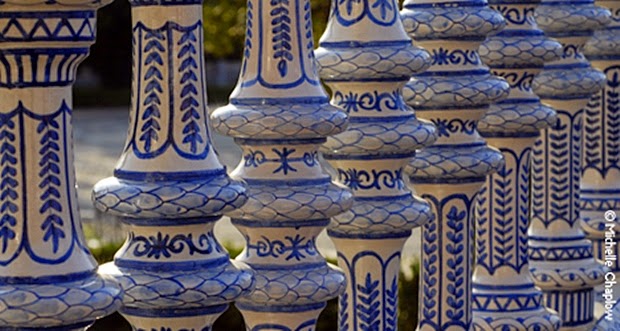
Azulejo may present itself bare in design, or overly intricate and ornate and therefore suited to the more baroque architecture. It may ornate church façades, imposing state and public buildings, and private residences, not to mention street infrastructures (fountains, benches, signage, or even bridge balustrades). The latter's most famous depiction as a testimony to the craft, is visible on Plaza de España (Seville), as part of the ensemble erected for the Ibero-American Exposition of 1929, an altogether landmark example of the Spanish Renaissance Revival style.

Not only are azulejos found in the great outdoors, but also in the great indoors, where they clad the floors, walls, ceilings and courtyards of monasteries, churches, universities, public buildings and private houses alike, sometimes in pure carpet style decoration where they enrobe every curve and movement of a surface, including arches, window surrounds and seats. Ornate tiles may be used as a decorative accent, as a border (frieze) or lintel, or more dramatically repeated over as a single motif piece, from floor to ceiling.

Azulejo Portuguese

Azulejos may be abstract or figurative in design, with earliest examples of azulejo being purely geometric as they were directly influenced by zellige. Each individual piece of tile may be painted in such a way that it represents only a fragment of a design element that is part of a bigger picture once assembled together with other tiles in a definite sequence in order to form a fresco or a mural, where it may go beyond the decorative and the trompe l'oeil, by relating a story, depicting a religious scene or edifice, or commemorating a battle.

Beyond the ornamental value of azulejos lies a more practical reason: the tiles keep interiors fresh during the Summer months, and dry during the rain season. The tile heritage has remarkably lasted well into the present day. Six centuries on, azulejos are still being produced, to the delight of design connoisseurs and tradition lovers, either through loyal representation of classic style, or in a more avant-garde albeit surrealistic interpretation, as seen in the Lisbon metro stations and La Casa de Música (Porto).

There certainly is a remarkable symbiosis between the solemnity of stone and the merry sobriety of tile, like a cheerful candy package cleverly unwrapping parts of a candy, as encapsulated by La Igreja Matriz de Cambra:-

Igreja Matriz de Cambra, Vouzela, Portugal
Casa de los Azulejos

Upon those sweet considerations, The Tile Files are tip-toeing out of those magnificent monuments. We will be back next month, yet should the prospect of the wait make you feel blue - you have every reason to feel that way - as our next visit will take us north to explore a close variant of azulejo - therefore expect more hues of blues!

Sources: (1) Paróquia de Santa Marinha de Cortegaça, Portugal, via Metalocus. Additional information about the flamboyant church, via Wikipedia (in Portuguese). Original photography by Markus Brunetti, part of his 'Façades: Kathedralen, Kirchen, Klöster in Europa' 2014 photographic exhibition. (2) Bridge balustrade, Plaza de España, Sevilla, photography by Michelle Chaplow, via Andalucia.com. (3) Azulejo Portuguese, part of the Azulejos Portugueses album by rhox2, via Flickr. More azulejo delights from the Azulejo Flickr group! (4) Igreja Matriz de Cambra, Vouzela, Portugal, photography by Sandra Coutinho, via Wikipedia. (5) Interior courtyard of Casa de los Azulejos, Mexico City, photography by Anthony Sloan, © Estate of Anthony Vail Sloan, 2009.

Additional Resources:

18 Jul 2014

Airs and Graces in the Garden

Gardens are works of art in motion and they come into their own in the Summer. They exhale their airs and graces, flowers bursting open to liberate enchanting aromas and riots of colours, long grasses swaying gently to a lukewarm breeze, butterflies delicately fluttering about, busy bees minding their own business, while the sun casts its indulgent glow like a gloss-over that enshrines beauty captured in the moment...
 

Sources: (1) Bee House, via Decoclico. (2) 'Verbena bonariensis', photography by LiamLondon (Liam Donnelly), via Flickr. (3) Colaptes auratus, 'Northern Flicker (Yellow Shafted) on a Tree Limb', photography by Lee Hunter via IBC (The Internet Bird Collection). (4) 'How To Make a Basil Mojito', via Drizzle & Dip. (5) 'A Cricket Playing Hide-and-Seek', via our sister blog La Baguette Magique.(6) Natural Rattan Garden Chair and Footstool by Sika Design, via Decoclico.
Related Posts Plugin for WordPress, Blogger...