Welcome to Mirabelle's brand new monthly design series,
The Tile Files. Forget "Be There or Be Square", as square wasn't a shape we started off with last month! Instead we went for hexagonal, paying particular attention to the Provençal
Tomettes. This month is a different set of rules as we are up for
flamboyance and opulence as a resonance of one to the other. We are about to admire those highly-decorative hand-painted tin-glazed ceramic tiles - mostly blue in colour - that are described as the pillar (elements) of
traditional architecture in Portugal, Spain and their former colonies of Latin and South America. The tile technique is also found in The Philippines. Anyway why go cryptic when
Azulejo is our brightly-coloured answer!
As tempted as we might be to associate Azulejo with Azul ('blue' in Spanish), it derives in fact from Arabic
Zellige ('polished stone'), a tile decoration technique directly influenced by Roman mosaics and later perfected by the
Hispano-Moresque.
Azulejo is a tale of
brio and panache: it is meant to get your attention! The colour that traditionally defines the azulejo is blue, due to the fact that when the artform had reached its pinnacle in the 17th century, it was being influenced by the white and blue duo scheme from the
Ming Dynasty porcelain. The traditional azulejo focuses upon a palette of blues which, in their hues and effects, provide depth and
perspective against a neutral (i.e. white) background. Yet in earlier times, azulejo included richer and warmer colourways, as testified by
La Alhambra de Granada (Spain).
Azulejo may present itself bare in design, or overly intricate and ornate and therefore suited to the more
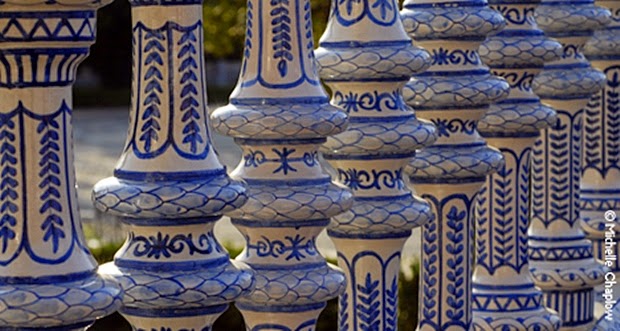
baroque architecture. It may ornate church façades, imposing state and public buildings, and private residences, not to mention street infrastructures (fountains, benches, signage, or even bridge balustrades). The latter's most famous depiction as a testimony to the craft, is visible on
Plaza de España (Seville), as part of the ensemble erected for the
Ibero-American Exposition of 1929, an altogether landmark example of the Spanish Renaissance Revival style.
Not only are azulejos found in the great outdoors, but also in the great indoors, where they clad the floors, walls, ceilings and courtyards of monasteries, churches, universities, public buildings and private houses alike, sometimes in pure
carpet style decoration where they enrobe every curve and movement of a surface, including arches, window surrounds and seats. Ornate tiles may be used as a decorative accent, as a border (frieze) or
lintel, or more dramatically repeated over as a single motif piece, from floor to ceiling.
Azulejos may be
abstract or figurative in design, with earliest examples of azulejo being purely geometric as they were directly influenced by zellige. Each individual piece of tile may be painted in such a way that it represents only a fragment of a design element that is part of a bigger picture once assembled together with other tiles in a definite sequence in order to form a fresco or a mural, where it may go beyond the decorative and the
trompe l'oeil, by relating a story, depicting
a religious scene or
edifice, or
commemorating a battle.
Beyond the ornamental value of azulejos lies a more practical reason: the tiles keep interiors fresh during the Summer months, and dry during the rain season. The tile heritage has remarkably lasted well into the present day. Six centuries on, azulejos are still being produced, to the delight of design connoisseurs and tradition lovers, either through loyal representation of classic style, or in a more
avant-garde albeit surrealistic interpretation, as seen in the
Lisbon metro stations and
La Casa de Música (Porto).
There certainly is a remarkable
symbiosis between the solemnity of stone and the merry sobriety of tile, like a cheerful candy package cleverly unwrapping parts of a candy, as encapsulated by
La Igreja Matriz de Cambra:-
Upon those sweet considerations,
The Tile Files are tip-toeing out of those magnificent monuments. We will be back next month, yet should the prospect of the wait make you feel blue - you have every reason to feel that way - as our next visit will take us north to explore a close variant of azulejo - therefore expect more
hues of blues!
Sources: (1) Paróquia de Santa Marinha de Cortegaça, Portugal, via
Metalocus. Additional information about the flamboyant church, via
Wikipedia (in Portuguese). Original photography by
Markus Brunetti, part of his '
Façades: Kathedralen, Kirchen, Klöster in Europa' 2014 photographic exhibition.
(2) Bridge balustrade,
Plaza de España, Sevilla, photography by
Michelle Chaplow, via
Andalucia.com.
(3) Azulejo Portuguese, part of the
Azulejos Portugueses album by
rhox2, via
Flickr. More azulejo delights from the
Azulejo Flickr group!
(4) Igreja Matriz de Cambra, Vouzela, Portugal, photography by
Sandra Coutinho, via
Wikipedia.
(5) Interior courtyard of
Casa de los Azulejos, Mexico City, photography by
Anthony Sloan,
© Estate of Anthony Vail Sloan, 2009.
Additional Resources: