Showing posts with label design. Show all posts

25 Feb 2018

Art Déco Showtime, Paris, 1925

The international design fair Exposition Internationale des Arts Décoratifs et Industriels Modernes, held in Paris in 1925, was the catalyst for the most significant worldwide Art movement of the 20th century. The Expo was an acknowledgement, a coming of age, a culmination of form and function know-how into Art Déco. It gave it prominence and status, the lettres de noblesse it deserved. The fair was a resounding success with the general public, and yet at the same time it was criticised by artists and insiders for its somewhat elitist approach, for its ostentatious display of deluxe utopia, and ultimately for its disconnect from the reality of the world. Its wasteful character was panned too as the luxury pavilions hosting the show were only to be temporary structures, meant to be dismantled afterwards, not kept in-situ. Yet no expense was spared for the event: a frivolity, as post-war reconstruction was costing the nation a pretty penny and moods were still sombre from the destruction of war. There was though no better way to introduce Art Déco to the world than with a bang!

Porte d'Honneur, photography by Georges Buffotot.

The necessity of rebuilding cities, towns and villages was handled hand in hand with foresight in order to bring style into livelihoods. Thus modernism in its clean lines, in its avant-garde, optimistic, future-embracing approach, was elected. The brief was all about breaking away from previous styles while cultivating a strong personality. WWI had profoundly broken the West and there was a willingness to start afresh, to start anew and to give design one's best shot and inject awe, pride and a strong presence into it! This didn't just affect architecture. Art Déco spilled across the decorative arts and crafts, clothing fashion, automobile, graphic design, typography, product design and more.

Art Déco celebrated a renaissance:
the return of life after the sheer brutality of war.

The Art Déco phrase was coined right out of the Expo's name; Art Déco being short for Arts Décoratifs (Decorative/ Applied Arts). Finally the movement that had been organically spreading since after the war, and which was gathering momentum, had a name. A French name that would come to be recognised all over the world without the need to translate it into a different language. Now, almost a century later, the prospect of diving straight into the rare photographic testimonies of the Expo, laid out for us by the Musée des Arts Décoratifs itself, is pure delight for every Art Déco fan and historian!

Boutiques du Pont Alexandre III: Boutique No.26, Siegel.

Source: All photography via the Exposition Internationale des Arts Décoratifs et Industriels Modernes dossier by the Musée des Arts Décoratifs. (1) Porte d'Honneur, night time photography by Georges Buffotot, Fonds Edition Albert Lévy, inv. EAL-011. Photo distr. © Les Arts Décoratifs/ Editions Albert Lévy. (2) . (3) .

Master craftsman Edgar Brandt was involved in the construction of the Porte d'Honneur.

9 Jan 2018

Happy New Year from Yesteryear

As the New Year is kicking into gear, and our idea of the obligatory New You is following suit, it is all too tempting to map it out of Brand New Things as opposed to just New Things! Now hold on. How about turning back the clock, especially as far as those vintage French New Year fancy cards (a.k.a. mignonettes) are concerned?

Bonne Année (1908)

The design of those yesteryear cards bears more gusto and compulsion than today's watered-down/ minimalistic representations. Look at those freestyle calligraphic fonts embossed in gold dust and swathed in flowers, a call for Spring in the thick of Winter: how dainty and desirable are they!

Bonne Année (year unknown)

Picture the scene: you get ready for breakfast, check the post as coffee is percolating away, and bring back half a dozen of those adorable mignonettes from the letterbox to your kids and spouse. Open them together and relish on the sweet words sent out to your family by other loved ones, as you sip café au lait and munch on chocolatines. Rejoice in the knowledge that the senders are receivers too as they too are experiencing the tokens of family joy which you sent them. 

Happy New You, Y'All!

Bonne Année (1912)
Bonne Année (1909)
Bonne Année (1906)
Bonne Année (1908)

Source: Move over, eBay, the big boys are in town! Delcampe is the specialised ephemera auction site from Belgium that describes itself as the greatest marketplace for collectors, with a current offering of almost 80 million items from the world over - I kid you not!

Postcards (> 46.4 million items to choose from!), postage stamps (> 22.8 million!), books, magazines and comics (> 2.6 million), old papers (> 2.5 million, anything from autographs to invoices and lottery tickets!), numismatics (> 1.1 million!), and other collectibles (> 3 million, including photography, advertising and music). From the commonplace to the rare collector piece, from the affordable to the extravagant, from the dilettante à la Mirabelle to the serious hobbyist à la J. Paul Getty, Delcampe has it covered.

Bilingual, so why not? A Happy New Year (1908)

You may kickstart your collecting career with less than five dollars to spare, making you the proud owner of a 100-year-old greeting card (see above). Collecting has to start somewhere and it might as well start with those as the risk factor is close to nil. Note the strong use of symbology for love, luck, happiness, peace, eternity and prosperity: heart, four-leaf clover, horseshoe, lily of the valley, dove, forget-me-not and mistletoe. (1) Bonne Année greeting card from 1908. (2) Bonne Année greeting card (year unknown). (3) Bonne Année greeting card from 1912. (4) Bonne Année greeting card from 1909. (5) Bonne Année greeting card from 1906. (6) Bonne Année greeting card from 1908. (7) A Happy New Year greeting card from 1908. Cards (1) to (6) are still available to purchase.

25 Nov 2017

The Art Déco Redesign of Saint-Quentin

It is high time Mirabelle paid its dues to a northern French Art Déco town which holds a special place in my heart: my hometown of Saint-Quentin! A born-and-bred saint-quentinoise, I spent my formative years there. I moved away for college before returning briefly home (for three years), and then onto the next leg of my personal journey, the UK.

Most of my family still lives in Saint-Quentin. My parents relocated to Corsica ten years ago and I followed suit from the UK approx. three years later. When my dad left Saint-Quentin, he left his heart behind - and probably even his soul. I left bits of myself behind and fragments of my heart too. Whether we acknowledge it or not, we all leave bits of ourselves behind whenever we up sticks.

Nouvelles Galeries, rue Saint-Jacques
ibid.
ibid.

We are ambivalent as to whether we should have moved away, whether we should have moved on with our lives. For my dad, this has proved virtually impossible after he was forced to sell our much-loved family home, a one-of-a-kind (unique) property whose elaborate construction and overall design he had been personally invested in every step of the way over the course of almost 35 years. A painstaking labour of love carved out of the best materials, using the best skillsets, that makes the house he lives in now a mockery (his words) if only in terms of architectural merit.

Mosaic ribbon (detail), rue de la Sous-Préfecture; another element of the façade is shown on pict. (13)

The irony of it all is that through our time in Saint-Quentin, none of us hardly took any photos of the town itself, none of us photographically recorded its beautiful, history-laden architectural heritage which was the background to our every day. A faux-pas which I reiterated in Manchester! So once again, I find myself reliant upon other people's photography in order to relate a part of my personal, intimate history.

Trade 'Commerce' medallion on a façade, rue de la Sellerie, carved out by French sculptor Raoul Josset

The moral of the story: do not take for granted the locale you live in. Pay attention to it, observe it, acknowledge it and immortalise it with your camera (or your paints and brushes or pencils).

Because this article just so happens to be a tale of ironies, the other irony is that while living in Saint-Quentin, we didn't pay much attention to its Art Déco architecture. We took note of the older (albeit rare) buildings that survived WWI ravages (and to a much lesser extent WWII ravages), namely the Basilique Saint-André (Basilica), Hôtel de Ville (Town Hall), Palais de Fervaques (tribunal) and theatre, all of which were extensively renovated post-war. Scattered vestiges here and there also survived the war. In actual fact, roughly 70% of Saint-Quentin was destroyed by the Great War.

Criée Municipale frontage, place Gaspard de Coligny

Now prepare for some home truths in this tribute:

Art Déco architecture was such an element of our daily lives - we bathed in it - that we found it too mundane and ordinary, to be worthy of any value. We didn't notice its merit, nor did we recognise it formally as a component of the internationally-celebrated design movement. We appreciated it only for what it was: an architectural style that characterised our town (and other northern towns and villages) and made it functional, rather than functional, innovative and eye-pleasing. We did not sing its praise. Rather, it just happened to be there, a mere landscape to our lives.

Brochure, via Calaméo

In retrospect, I wish I had paid attention. I hear you suggest that I could return to Saint-Quentin to soak it all in and capture it but nostalgia, and generally the memory of loved ones gone, times gone and a way of life gone, have ways to make you sea-sick. And this is the pain I have interiorised. Maybe after all, we shouldn't have gone in the first place. Just stayed put. But is this what life is about? Stay put? Deprive yourself of brand new adventures?

Buffet de la Gare, train station restaurant mosaic (detail)
Forged iron and bevelled glass door (detail), rue Voltaire

Now let us be clear. To label Saint-Quentin as strictly an Art Déco town (as modern-day historians tend to do) is a fallacy. It deprives it of its rich, long and checkered history: founded by the Romans, sacked and looted by the Francs (in 406), then by Atilla the Hun (in 450), and later by the Barbarians (in 531). Not to mention other charming visitors like the Spanish conquistadores and the Prussians. Saint-Quentin's strategic location as a gateway to northern and Eastern Europe, made it a geopolitical hotspot and a battlefield, as well as an intersection point between paganism and christiandom.

The Casino cinema, built 1929, a flamboyant landmark

The prevailing Art Déco style across our northern town reflects the fact that 3/4 of its pre-WWI buildings had been blitzed out by war. Thus no expenses were spared when reconstruction came about. This coincided with the flourishing movement of the time, Art Déco, using a variety of materials (brick, stone, slate, marble, granite, mosaics, stained glass, enamel, concrete, plaster, forged iron, stainless steel, bronze, brass, copper, lead, wood) and a palette of techniques that heralded the new and the bold while grounding it into a solid classical approach in terms of proportions, perspective, materials and general elegance. The constructions were made to last the distance in terms of both appeal and quality, not be demolished on a whim within a couple of generations.

Local architectural firms, as well as those from Paris, Lille or nearby, all delighted in the prospect of showcasing their know-how, and added quirky touches as they came up with residential, commercial, institutional and industrial premises, not to mention train stations, churches and war memorials, that lived up to their name, reputation and promises.

Art Déco translated the wave of post-war optimism into a movement. No solemnity to it, only a hymn to joy and oppulence meant to affect everyone positively, if only by way of a little architectural beautification, whatever came to play to perk up a nation raw from the horrors of the Great War.

Over several years, in certain cases to the dawn of WWII (or beyond for churches), the reconstruction of France and other war-torn nations was akin to a beehive of ingeniosity writing the book of 20th century design and paving the way for the mid-century modern of later years. Artisans and craftsmen were an integral part of the workforce, hence process. My great grandad, Joseph, a marine carpenter by trade, travelled all the way from Brittany to Saint-Quentin with his family in order to provide his sought-after skills to the building trade.

The Conservatoire Municipal (Music Academy) lobby area

After all, mass-consumerism hadn't quite cut its teeth into society just yet. France was still being built up out of wares that had been made in France! There was this fierce, strong sense of belonging and the Nation State. Personalisation, customisation and innovation played an important part in Art Déco craftsmanship. The result was an architectural equivalent of fashion haute couture or a quality off-the-peg piece, rather than ready-made, pre-assembled ensembles churned out on an industrial scale. Ironwork was hot off the local forge, not off Home Depot.

Decorative terracotta grapevine relief band, residential property, Champs-Elysées area?

All these elements fuse together into lessons in contemporary design and late neo-classicism that many a modern-day architect worth their salt should embrace rather than run from or deride. I cannot bear to think what our towns and cities would look like if they were being rebuilt today, under this post-industrial, post-craftsmanship styleless, paradigm of using cheap and cheerful one-size-fits-all Far-East imports that line up the shelves of DIY chain stores. I can all too painfully notice its ravages at a local level (in Corsica), the breeze block-plasterboard-PVC residential combos with their utterly charmless personality-devoid utilitarian Soviet finished look. Life is meant to be celebrated, not mourned, which is why Art Déco should make us thankful. Rejoice, people, rejoice!

Glass and metal front door, rue de la Sous-Préfecture; another element of the façade is shown on pict. (4)

Sources: Art Déco knows no blandness. Art Déco as a movement created bold, awe-inspiring, sculptural - even flamboyant - statements. Think the Chrysler Building! Made up of bold, aerodynamic, streamlined curves, abstract patterns and geometric florals and feathers, it is meant to be embraced from a distance and appreciated up close. A celebrated duo of form and function that epitomises good design and relishes both its clean lines and intricate vignettes and frescoes. Born just after WWI, the artistic and architectural movement swept across the world and span across the Roaring Twenties and Depression Era.

Front door (detail) of the Grande Poste (central post office)

(1-3) Construction of the Nouvelles Galeries retail store started in 1922, and the store opened to the public five years later. Despite the building having been disused for the last 50 years, it has nonetheless managed to keep visitors spellbound to this day. While awaiting an hypothetical renaissance, the site has found its vocation as an exhibition hall for... Art Déco exhibitions! (1) Photography by Julien Sarrazin, via On Teste Pour Vous en Picardie. (2) La folle expo d l'Art  Déco, photography via Art Déco de France. (3) Photography via the city of Saint-Quentin's official website. (4-5) L'Art Déco à Saint-Quentin, photography by Jean Triboulloy and Michèle Wojciechowski. (4) Mosaic ribbon (detail) fringing the façade of a much-photographed Art Déco maison bourgeoise residential property, located next to the sous-préfecture. See its panelled glass and ironwork door pict. (13). (5) 'Commerce' medallion on a façade, rue de la Sellerie, carved out by French sculptor Raoul Josset. Interestingly the prolific sculptor moved to the USA in order to pursue his craft under the Art Déco influence; he created larger-than-life statues in his adopted state of Texas. (6) Criée Municipale, unattributed photography via Nicole Boxberger. It features a concrete curved one-storey building that used to host the municipal fish market. I remember it operating until at least 20 years ago. Under the town hall's Art Déco preservation and renovation programme which provides incentives and professional advice to eligible property owners from both the public and private sectors, the Criée was renovated. Its lettering, which used to be a tomato red on cream, has now been given a flattering blue floral treatment that lends panache and a little relief to the signage. The neat Art Déco typeface is pure typographical delight! (7) Art Déco has taken centerstage in Saint-Quentin only recently, over the last 25 years. Prior to that, the movement might have been perceived as being still too recent in order to deserve acknowledgement and critical acclaim from local historians, the local authorities and the local population alike. The brochure 'Raconte-moi l'Art Déco à Saint-Quentin' was published by the Local Authority (Agglomération du Saint-Quentinois), and is available to read via Calaméo. (8-9) Photography by Pascal Stritt, featuring (8) the mosaic detail of the Buffet de la Gare (train station restaurant), and (9) the forged iron and bevelled glass door, rue Voltaire. (10) Inaugurated in 1929, the flamboyant Casino cinema and music-hall is flanked by two pilasters topped by carnival heads, Jean qui rit (the laughing John symbolises comedy) and Jean qui pleure (the weeping John symbolises tragedy). The heads used to spook me stiff every time I went past! (11) The Conservatoire Municipal (music academy) is a gem of Art Déco fusion, with its façade bearing a distinctive flemish style flanked by bow windows. (12-13) Photography by Sandra Cohen-Rose and Colin Rose, via Flickr. Their photography portfolio is a collection of (mostly) Art Déco architecture, including architectural artefacts (plaques, reliefs, friezes, etc.) from around the world. (12) Decorative terracotta grapevine relief band on the façade of a residential property believed to be in the vicinity of the Champs-Elysées municipal gardens. (13) Glass and metal front door, rue de la Sous-Préfecture. Cf. pict. (4) for another element of the façade. (14) Glass and metal front door detail of the imposing Grande Poste (central post office), located nearby the Basilica. Photography by MEL.A, via Instagram. René F. Delannoy was the architect (1929). The account features more Art Déco views of Saint-Quentin. (15) Photography by Pascal Stritt, of one of the tin plaques that decorate the bar of the Restaurant des Champs-Elysées, rue de Baudreuil. (16) The Art Déco movement is now celebrated every Spring in Saint-Quentin and neighbouring towns.

Tin plaque, Restaurant des Champs-Elysées, rue de Baudreuil

Further Resources:

A yearly celebration of Art Déco in Saint-Quentin

_________

* The acute accent on the letter 'e' of Art Déco is my deliberate attempt at translating the fact that the Art Déco movement originated from France. It derives its name from the Exposition Internationale des Arts Décoratifs et Industriels Modernes held in 1925 in Paris, an event which came to be known as a catalyst of the Art Déco movement.

* Last updated 12-Apr-2018.

18 Nov 2017

Investment Pieces for the Home: Rose Uniacke

If money is no object and the object of our affection is an interior exuding European old money grandeur, a trip to Rose Uniacke's furniture showroom and interior design studio in Pimlico, London, beckons. The interiors' Queen of Serene will help you make it happen and morph your dream home into a reality.


Rose's credentials are rock-solid and her offering a one-stop shop. Her knowledge base as both an interior and product designer, in addition to her understanding of family-friendly, functional, cosy personable interiors, combine with her invaluable experience as an antiques dealer, fabric designer, gilder, paint and lacquer specialist and furniture restorer, her respect for the history and style of the buildings they sit within, the importance of sensible renovation involving the cream of craftsmen and experts in order to turn the house into a workable and lovable space with its integrity of character, and the carefully-curated heirloom objects that weave a fine balance of form and function into the canvas of the property. 

Rose translates her clients's wishes and expectations into homes that intimately fit their personality: homes that are an extension of who they are. Her client base includes household names such as David and Victoria Beckham and perfume maestro Jo Malone, should you care to know. As may be judged from her portfolio, Rose is used to juggling £multi-million property renovation contracts, without compromising on craftsmanship or style. Cleverly mixing the old and the new in a balancing act only she knows how will usher you to the past without nostalgia while by the same token keep you in the present with a well-honed sense of history. Your home is in safe hands with Rose Uniacke and her team.

Arts & Crafts Repoussé Lantern, England, c.1900 (£2,700/ $3,569)

Now here is my shortlist of unique pieces which no home with a healthy cashflow should be without. I do admit the prices are extravagant but do not let this hold you back if you are prepared for style no matter the cost! Bear in mind the pieces are bold, unique and in good condition.

Source: (1-5) Rose Uniacke's Pimlico home is a pared-down affair that peeled off the layers of successive conversions to its bare walls, complete with restored plasterwork and mouldings. The 19th century property was originally a professional artist’s combined studio, gallery and private residence. It was later converted into a smaller residence flanked by four apartments. Rose reverted it back to a family home, complete with wine cellar and interior courtyard plus the modern conveniences of home cinema, spa and pool - without betraying the essence of the building. In such a setting, heirloom pieces like the (3) 19th century waterfall chandelier (attributed to the Spanish Royal Glassworks), effortlessly come to life. More photography from the Vogue slideshow and article (March 2017), photography by François Halard. (6-8) Antique items available to purchase from the Rose Uniacke online shop. (6) The Arts & Crafts Repoussé Lantern (£2,700/ $3,568.60) will add some Gaudí-esque brass drama to the entrance lobby. (7) The Large French Ormolu Alabaster Hanging Light stands out in style and price, a cool £12,000/ $15,860. The original ormolu bronze includes the foliate mounts and canopy; the veined alabaster dish will bathe your sitting-room in flattering soft indirect lighting. (8) Recently reduced in price, the Finely Cast Victorian Brass Table Lamp by George Smith is almost a snip at £1,100/ $1,454. (9) Note the original three lion-paw feet on a tripod plinth supporting the fluted column.

Large French ormolu alabaster Hanging Light, France, late 19th century (£12,000/ $15,860)
Finely Cast Victorian Brass Table Lamp by George Smith, England, c.1850 (£1,100/ $1,454)
Close-up of the lion-paw feet on a tripod plinth

22 Oct 2017

Crumbling Châteaux

With modern times achanging, old money does not warrant stability and continuity: one way or another the estates it relates to likely meet their fate. Heating bills, maintenance and repair costs, and property taxes end up sealing the deal on one remorseless Winter night.

Passed down the generations, the estates increasingly turn into financial burdens (financial money pits!), unless pockets are deep and/ or resourcefulness (return on investment projects), DIY skills, family team spirit and general stamina are unequivocally high.

Château de la Mothe-Chandeniers (dating back to 13th century), Les Trois-Moutiers, Vienne, France

Maybe any land-related business attached to the estate (farming, winemaking, fruit orchards, garden nurseries, crafts, hospitality) which used to support or supplement its income ends up folding altogether due to high running costs and other expenditures - and the implacability of French taxation (so be said). The château lifestyle may then take a turn for the worse and bite the dust...

Likewise the French château dream may turn sour for those idealist buyers and unpractical investors who succumbed to the lure of a quick, cheap and fanciful purchase, only to find out that they are biting more than they can chew. And then the château lifestyle increasingly becomes a distant vision. 

Château de Maupas (built c.1580), Maupas, Dordogne, France

I have little knowledge about the history of the châteaux featured herein - and the reasons that led to their falling from grace. Regardless, my aim is not to blame or condemn. Mirabelle knows only too well how easy - very easy - it is for a property - grand or otherwise - to fall into disrepair, catch you off-guard, and for its maintenance costs to escalate beyond repair, especially when the property has not been consistently looked after or if you have been dealing with cowboy builders and other rip-off con artists from the associated building trades. Those elderly ladies made out of stone, brick, slate and wood require constant methodical TLC: choose to disregard or overlook it at your peril!

Château de la Boissière (dating back to 19th century), Edern, Brittany, France

Some owner-renovators and passionate volunteers are riding the wave high and proud and making a success out of their property venture, through blood, sweat and tears. First expect cold sleepless nights, spartan comfort, improvised dinners out of a camping stove, and chamber pots for toilets... Or best make a caravan your home while a modicum of comfort is being established in your property. All in all, keep at it and never lose sight of the reward at the end of the dirt track, beyond crumbling plaster and patches of dry rot!

Château de Coat an Noz (built 1870), Belle-Isle-en-Terre, Brittany, France

Source: (1-5) French château photography via Châteaux de France. (1) Château de la Mothe-Chandeniers (built 13th century), Les Trois-Moutiers, Vienne, photography by Pierre Mairé. (2) Château de Maupas (built c.1580), Issac, Dordogne. (3) Château de la Boissière (dating back to 19th century), Edern, Brittany, and (4) Château de Coat an Noz (built 1870), Belle-Isle-en-Terre, Brittany, photography by Morgan Corbet. (5) Château de Bonnefontaine (built 1818-1822), Altwiller, Alsace. (6) Château de Blancafort (built 1453), Sologne, Loire Valley. (7) Château de Meauce (built c.13th century), Nivernais.


Château de Bonnefontaine (built 1818-22), Altwiller, Alsace, France

Depressed about the château sorry state? Cheer up and read on...


Château Success Stories:

  • Adopte un Château, in partnership with Dartagnans, presents itself as an innovative crowdfunding scheme designed to bring together investing members of the general public willing to be involved in the rescue of a struggling château that has fallen into disrepair. The initial goal is for the investors to collectively meet the seller's asking price. By purchasing one or more shares (affordably priced at 51 euros a share), they become in effect one of the several owners who will be involved in the château's future, with its renovation funded by its conversion into a profitable business. This is exactly what is happening to our featured (1) Château de la Mothe-Chandeniers right now! Now whether the scheme has real potential for the safeguard of a château - or is purely utopic - remains to be seen, especially in the long term.
  • Push open the door to a successful privately-owned current château renovation scheme: Château de Meauce (built 13th century), set in Nivernais, the Central area of la belle France. The château is featured on the Adopte un Château website.
  • Follow the river and admire the quintessential châteaux of the Loire Valley: those are healthy and wealthy! And while you're at it, take a leisurely stroll through the grounds and the gardens
  • If your pockets are deep and you envision yourself as the proud owner of a renovated château in Sologne, within the Loire Valley, you are in luck! Château de Blancafort (built 1453 as a fortified stronghold) is up for auction... and already has your name on it! 
  • Purchased in 2015 by TV personality Dick Strawbridge and his wife Angel Adoree, Château-de-la-Motte Husson is the star of a (British) TV home renovation series. The Loire Valley-located château (which finds its origins in Medieval times and was rebuilt 1868-1874) also hosts vintage weddings and other hospitality events under the umbrella of The Vintage Pâtisserie, Angel's hospitality company.
  • In the French Pyrenees village of Château-Verdun, Château de Gudanes (built mid-1700s) is too enjoying a second youth! Its new owners are a couple of  dynamic Aussies who gave up their home comforts from Down Under for a château life made up of cracks, leaks, drafts, overdrafts... and much joy! The château restoration is well underway now and paying off! In fact, each Summer paying guests are invited to contribute their skills in exchange for a slice of the pie

Château de Blancafort (built 1453), Sologne, Loire Valley, France
Château de Meauce (built c.13th century), Nivernais, France (pict source)

30 Sept 2017

Green with Envy

Rich Autumn colours of Burgundy and pomegranate reds, pumpkin orange, chocolate brown and aubergine purple are all well and good but when green ordinarily sends your heart aflutter, gives a spring to your step and takes nature indoors into a house party celebration of the bounties of life, there is simply no forsaking the colour green for a change of season.

There is not a more visual way to stamp personality onto a home than through wallcoverings and Style Libray is a worthy starting point. Now if green is your cup of green tea like it is mine, they have a sampled variegation of greens to explore at our leisure...

"Have nothing in your houses that you do not know to be useful or believe to be beautiful." - William Morris

'Cashmere Paisley' wallpaper by Sanderson

As the largest soft furnishings group in the UK, Style Library operates a portfolio of six British brands, two of which of iconic, heritage status Sanderson  and Morris & Co. Sanderson, established 1860 in Islington, London, by Arthur Sanderson, was awarded the Royal Warrant in 1923 and then again in 1955. Morris & Co. was established 1861 by famed textile designer, typographer, poet, philosopher and political theorist William Morris (1834-1896). Mr. Morris is associated with the Pre-Raphaelites and the English Arts & Crafts Movement. His wallpaper designs translate naturalism through the Aesthetic style.

The other brands under the Style Library umbrella are luxury wallcovering creator and archive curator Zoffany, colour trend-setter Harlequin, Scandi-inspired and Mr. Fox prints Scion, and contemporary wallpaper designer Anthology.

'Verdure' fabric by Zoffany
'Strawberry Thief' wallpaper by Morris & Co.
'Caverley' fabric by Sanderson

Sources: (1-5) Style Library. (1) Rest assured: this frilly foliage is no fuddy-duddy! The 'Cashmere Paisley' wallpaper (colourway code: DART21680) is part of the aptly-named Art of the Garden botanical wallpaper collection by Sanderson. A fresh and dainty paisley design in a sage colourway that is more neutral than feminine, Cashmere Paisley will light up a North-facing room like no other. Pair with white-painted woodwork in satin finish and a quality sisal floorcovering to add warm texture. To make the room shine boldly, introduce a statement Murano glass floral chandelier in a contrasting coloured glass of pink or blue. Without a shadow of a doubt, that North-facing room of yours will start enjoying the bright side of life!

(2) For those of us who seek a heritage linen fabric that does not look like it belongs in the National Trust, 'Verdure' (colourway code ZAMW320465) by Zoffany is worth considering. Based on a late 17th century painted cloth, Verdure will take your windows on a wondrous wander across pastoral lands. With the church in the background and tea-time beckoning, the only question on your mind will be: 'More tea, vicar?' The design has a modern (Art Nouveau) quality to it and the teal green oscillates between turquoise and slate.

Green paint shades, top row from left: Misty Mint, Queen Anne Green Light and Green Shoot (all three by Sanderson); bottom row from left: Lime Cloud, Green Almond (both by Sanderson), and Fennel (by Zoffany).


(3) As an action-packed heritage wallpaper for a single feature wall contrasting with the other walls in a plain cream, 'Strawberry Thief' (colourway code DMCR216477) by Morris & Co. beckons. As the pièce de résistance to your dining room, it will be your conversation piece as soon as guests arrive and companion piece once they are gone. Originally a cotton fabric design, it was registered in 1883. One of the most popular Morris fabrics, it is now available as a wallcovering.

(4) For a bird theme that is less prominent than Strawberry Thief, combined with only a few hints of green supported by pops of floral pink on a mustard canvas (referred to here as Chinese Yellow), the 'Caverley' fabric (colourway DCAVCA202) by Sanderson does the trick. It resmbles a tapestry, with a Chinoiserie influence although the design is described as being 'typically English in style' despite its exoticity. It is based upon an early 19th century hand-block print.

(5) Green paint collage by Mirabelle. Paint shades, top row from left: Misty Mint, Queen Anne Green Light and Green Shoot (all three by Sanderson); bottom row from left: Lime Cloud, Green Almond (both by Sanderson), and Fennel (by Zoffany).

10 Aug 2017

Fresh, Crisp and Leafy

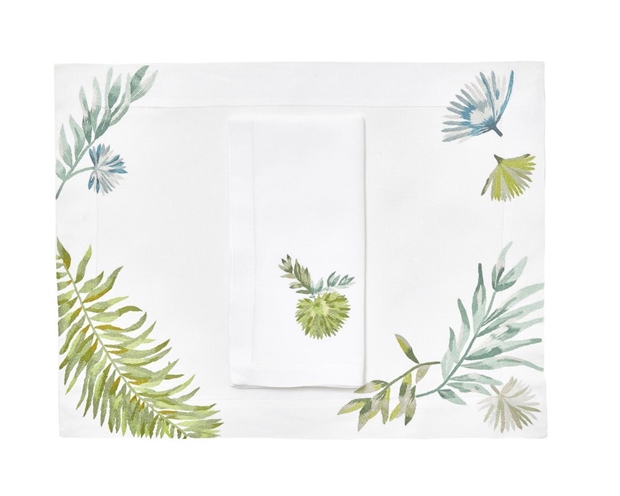
Mirabelle never imagined for one second that placemat and napkin sets would catch her eye, get her excited and get an article in the process with adjectives like fresh and crisp and leafy... When was the last time such adjectives were used in unison to describe those little accents of table linen?

Maybe placemats used to leave you indifferent too... until now! Because you and I hadn't yet crossed paths with the French luxury linen company D. Porthault, that's why!

Need a little convincing? Surely not as I can see you gaze admiratively at the exquisite artistic sets below... And since you're asking, Tempête Tropicale is my favourite. How about yours?

Tempête Tropicale
Anagramme Lilac
Mariage
Papyrus
Lilas Blue
Feuilles d'Olivier Soft Green

The sets represent only a tiny sample of D. Porthault linen collections: you really need to check those out for yourselves!

Always ahead of the game, The Glam Pad has just announced the imminent release of D. Porthault: The Art of Luxury Linens, a coffee table book showcasing those eponymous colour-rich home collection textiles, sure to brighten up our bedside cabinets as we move towards shorter days and longer nights. With such a book to hand, we'll naturally want to stay tucked up in bed just a little longer, flicking through the pages, enjoying the visual treats and redesigning our abodes! Sweet dreams and happy home projects to you!

Available to purchase from Gibbs Smith

Related Posts Plugin for WordPress, Blogger...