Showing posts with label Stellar5. Show all posts

21 Jan 2016

A Wonderful Winter Wedding...

If you follow Mirabelle's sister blog La Baguette Magique, you will have found out my big news: I just got married to the loveliest man there is, Roby! Our Big Day was an intimate affair - only close family members - and no lavish ceremony. It was all about pared-down simplicity.


Though needs to be said that we forfeited neither style nor elegance. However we dispensed of the following: wedding planner, professional photographer, personal florist, bridesmaids, wedding attire, hire limo, band/ DJ, private chef... and five-course banquet for that matter. Sorry if this may not be the idea of a fairytale wedding for some of you, yet for both Roby and I, it was exactly the way we both wished our Big Day to be: low-key and fuss-free. A by-product of low-key and fuss-free meant that our wedding came out to be inexpensive, yet not in the sense of tight-fisted or cheap, i.e. lacking the essentials or attention to detail. Ours was inexpensive *and* luxurious!


Here let me share with you a few hints and tips on how to achieve an inexpensive fuss-free wedding reception that does look the part:-


Wedding Venue:
The wedding lunch took place at my parents' house.

Table Decor:
Living on an island miles from the closest town, we had to make do in terms of floristry for instance. From the local general store, my mum picked a small cream rose bush whose pot she wrapped up in foil and then wrapped in a heirloom crocheted doily held together by an elastic band. She also picked a bouquet of mixed flowers (pink carnation, chrysanthemum, red rose, gerbera, pistacia lentiscus, papyrus, etc.) that she placed in a tall crystal vase.
Flowers instantly add grace and elegance!

Table Linen:
Family heirloom embroidered white linen that belonged to my grandma, dating back to the 1930s, and still in pristine condition. Our ultra-special family occasion linen!
Making a statement with heirloom pieces...

Tableware:
Making a statement with heirloom pieces, and going tone on tone, as white on white is so chic! White porcelaine de Limoges plates. Silverware & crystalware, family heirloom pieces from early 20th century to the 1960s.
... and white on white is so chic!

Menu Fayre:
Mostly buffet style finger food for the apéritif and first course, laid out on trays placed on the dining table: canapés (of thin gingerbread slices spread with fig and walnut jam and finished off with a layer of soft blue cheese); cherry tomatoes sliced halfways and held together on cocktail sticks with a dice of artisan smoked/ cured meat in the middle; courgette (zucchini) fritters; freshly-made mushroom pizzas from the local bakery, sliced in bite-size squares, shop-bought savoury palmiers, fresh grapes, cheese bites.
The Buffet Table

Main Course:
Scallops in a white wine sauce prepared by my mum, served straight off the oven in their individual fancy ramekins. 
Dessert:
Galette des Rois, ordered fresh from the bakery. The galette is an Epiphany pastry speciality from France, made up of puff pastry filled with Frangipane (almond paste). We personalised it by serving it with homemade candied kumquat slices and caramelised persimmon slices. [P.S: If you are feeling adventurous, why not make your own Galette des Rois, from scratch! Try David Lebovitz's recipe.]
Roby's favourite French sweet is a Christmas chocolate speciality called Papillote!

Beverages:
Champagne (Charles Lafitte and Alfred Rothschild et Cie) from apéritif through to dessert. Some dry white wine served with the scallops. Mineral water and upmarket apricot juice as soft drinks.
 Afters:
Black coffee served in English china cups, and chocolate fancies, including Papillotes.

Our wedding dog Tickle never got himself in a pickle with his wedding collar on!

Source: (1) Mirabelle montage of Magical Thinking Henna Letters 'N' (Nathalie) and 'R' (Roby) by Urban Outfitters. (2-9) Photography by Mirabelle.

12 May 2015

The Tile Files: Azulejos

Welcome to Mirabelle's brand new monthly design series, The Tile Files. Forget "Be There or Be Square", as square wasn't a shape we started off with last month! Instead we went for hexagonal, paying particular attention to the Provençal Tomettes. This month is a different set of rules as we are up for flamboyance and opulence as a resonance of one to the other. We are about to admire those highly-decorative hand-painted tin-glazed ceramic tiles - mostly blue in colour - that are described as the pillar (elements) of traditional architecture in Portugal, Spain and their former colonies of Latin and South America. The tile technique is also found in The Philippines. Anyway why go cryptic when Azulejo is our brightly-coloured answer!

Paróquia de Santa Marinha de Cortegaça

As tempted as we might be to associate Azulejo with Azul ('blue' in Spanish), it derives in fact from Arabic Zellige ('polished stone'), a tile decoration technique directly influenced by Roman mosaics and later perfected by the Hispano-Moresque.

Azulejo is a tale of brio and panache: it is meant to get your attention! The colour that traditionally defines the azulejo is blue, due to the fact that when the artform had reached its pinnacle in the 17th century, it was being influenced by the white and blue duo scheme from the Ming Dynasty porcelain. The traditional azulejo focuses upon a palette of blues which, in their hues and effects, provide depth and perspective against a neutral (i.e. white) background. Yet in earlier times, azulejo included richer and warmer colourways, as testified by La Alhambra de Granada (Spain). 

Plaza de España, Sevilla

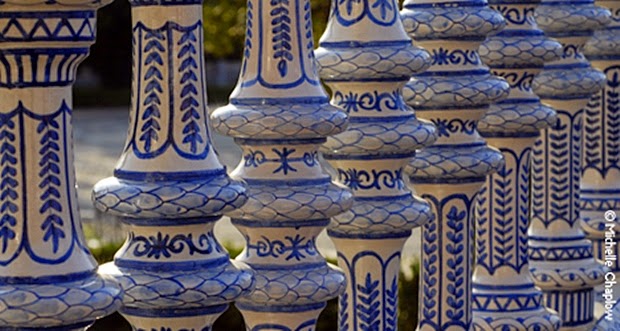
Azulejo may present itself bare in design, or overly intricate and ornate and therefore suited to the more baroque architecture. It may ornate church façades, imposing state and public buildings, and private residences, not to mention street infrastructures (fountains, benches, signage, or even bridge balustrades). The latter's most famous depiction as a testimony to the craft, is visible on Plaza de España (Seville), as part of the ensemble erected for the Ibero-American Exposition of 1929, an altogether landmark example of the Spanish Renaissance Revival style.

Not only are azulejos found in the great outdoors, but also in the great indoors, where they clad the floors, walls, ceilings and courtyards of monasteries, churches, universities, public buildings and private houses alike, sometimes in pure carpet style decoration where they enrobe every curve and movement of a surface, including arches, window surrounds and seats. Ornate tiles may be used as a decorative accent, as a border (frieze) or lintel, or more dramatically repeated over as a single motif piece, from floor to ceiling.

Azulejo Portuguese

Azulejos may be abstract or figurative in design, with earliest examples of azulejo being purely geometric as they were directly influenced by zellige. Each individual piece of tile may be painted in such a way that it represents only a fragment of a design element that is part of a bigger picture once assembled together with other tiles in a definite sequence in order to form a fresco or a mural, where it may go beyond the decorative and the trompe l'oeil, by relating a story, depicting a religious scene or edifice, or commemorating a battle.

Beyond the ornamental value of azulejos lies a more practical reason: the tiles keep interiors fresh during the Summer months, and dry during the rain season. The tile heritage has remarkably lasted well into the present day. Six centuries on, azulejos are still being produced, to the delight of design connoisseurs and tradition lovers, either through loyal representation of classic style, or in a more avant-garde albeit surrealistic interpretation, as seen in the Lisbon metro stations and La Casa de Música (Porto).

There certainly is a remarkable symbiosis between the solemnity of stone and the merry sobriety of tile, like a cheerful candy package cleverly unwrapping parts of a candy, as encapsulated by La Igreja Matriz de Cambra:-

Igreja Matriz de Cambra, Vouzela, Portugal
Casa de los Azulejos

Upon those sweet considerations, The Tile Files are tip-toeing out of those magnificent monuments. We will be back next month, yet should the prospect of the wait make you feel blue - you have every reason to feel that way - as our next visit will take us north to explore a close variant of azulejo - therefore expect more hues of blues!

Sources: (1) Paróquia de Santa Marinha de Cortegaça, Portugal, via Metalocus. Additional information about the flamboyant church, via Wikipedia (in Portuguese). Original photography by Markus Brunetti, part of his 'Façades: Kathedralen, Kirchen, Klöster in Europa' 2014 photographic exhibition. (2) Bridge balustrade, Plaza de España, Sevilla, photography by Michelle Chaplow, via Andalucia.com. (3) Azulejo Portuguese, part of the Azulejos Portugueses album by rhox2, via Flickr. More azulejo delights from the Azulejo Flickr group! (4) Igreja Matriz de Cambra, Vouzela, Portugal, photography by Sandra Coutinho, via Wikipedia. (5) Interior courtyard of Casa de los Azulejos, Mexico City, photography by Anthony Sloan, © Estate of Anthony Vail Sloan, 2009.

Additional Resources:

15 Apr 2015

The Tile Files: The Hex Factor

Welcome to Mirabelle's brand new monthly design series, The Tile Files. I am passionate about design and what makes a house look balanced, in terms of style identity. Flooring - and in particular floor tiles - feature prominently in my life as an amateur interior designer. A strong observation resulted from this: having had the privilege to visit dozens of properties throughout my life, what I have repeatedly and consistently noticed is how the choice of flooring impacts either positively or negatively upon the overall look and character of a property. It either enhances it considerably - or it unabashedly ruins it!

Exquisite Surfaces

This certainly was the case when a couple of years ago, some friends proudly showed me photos of their house in Normandy (northwestern France) that they had just put up for sale. The kerb appeal was enticing, lovely quaint 19th century country house in a mature garden, with period features retained. However as soon as you pushed the front door, shock horror! You were confronted with a 1980s revisit, complete with the open plan situation that had totally wrecked the expectations, and the cheap and nasty square glazed white tiles grouted black - my pet peeves! What we were left with was a house that had lost its charm and identity altogether.

The Metropolitan Museum of Art

However in this series, we will leave design mistakes aside and explore those classic and timeless designs, that have transcended decades - even centuries - and still to this day have stood the test of time, in terms of classical style.

ARTO's concrete versions of the Tomette

Let's start off with the Tomette, the tile that is traditionally associated with the Southern France (Provence and Corsica) of yesteryear. Tomette is a glazed hexagonal clay terracotta tile, in rich earthly tones, sizes may differ. Tomettes have the advantage of keeping a house cool in the Summer. My grandma's house in Corsica had its ground floor tiled in red tomettes, back in 1907, when the family house underwent extensive renovation, still in keeping though with the character of the house.

From personal investigations in unaltered older Corsican properties, I found out that traditional tiles were mostly square-shaped. However hexagonal tiles became vastly popular in the 19th century, up to WWI. I understand they brought a status symbol of comfort and social advancement to houses. After WWI, the popularity of the tomette declined steadily in favour of style incongruities for the older house that, despite bringing urban and modern into the home, defaced the character of many an older property: Granito, Formica, Linoleum, those throughout the 1950s and 60s.

Uncredited picture, via Tumblr

These in turn paved the way for cheap southern imports of mass-produced style-less charmless ceramic tiles. Meanwhille it seems that, driven by market demand for low production costs and a stiff competition from abroad, many a French tile company lost its way, in terms of design.

Fortunately out there, tile designers in the know are aware of the importance of legacy, tradition and sobriety of style. They have realised that old didn't have to mean old-fashioned. And why fix something that is not broken? Thus I am pleased to acknowledge the fact that those traditional French designs of yesteryear are now regaining some popularity on the home turf, while being praised and appreciated outside of France by connoisseur suppliers and customers.

Tabarka Studio
Tabarka Studio

To name but a few of those American tile companies supplying hexagonal terracotta tiles: Exquisite Surfaces, ARTO and Tabarka Studio. Click the links to find out about showrooms, resellers and distributors.

Meanwhile The Tile Files will be back next month, and we'll hit the tiles once more... with grace!

Sources: (1) Made in France, those Antique Hexagon Terracotta Tiles are available in traditional colors from Exquisite Surfaces who describe the tiles herein: "Nothing symbolizes French country flooring more than terracotta. The extraordinary warm colors, the beautiful hues and variations, the hand-molded shapes all define the essence and rustic charm of French country living."

(2-3) Those 15th century hexagonal tiles from New York's Metropolitan Museum of Art testify to the fact that hexagonal is no contemporary tile shape! (2) Hexagonal Tile from Mamluk Egypt, featuring a botanical design. The design of this tile was strongly influenced by Chinese models, in both composition and color. (3) Hexagonal Tile of Islamic culture found in Egypt, featuring the palms of a palm tree.

(4) Collage of four of ARTO's versatile interior/ exterior floor and wall concrete hex tiles that mimic the variegations and handcrafted elegance of terracotta, with extra durability. Clockwise from top left: {1} BB30 6'' Hexagon Normandy Cream Signature Series Tile; {2} BB173 6'' Hexagon Los Angeles Red Flash Vintage Tile; {3} BB44 6'' Hexagon Crème Fraîche Vintage Tiles; and {4} BB174 6” Hexagon San Clemente Vintage Tiles. All of the ARTO products are manufactured with concrete. Production has taken place in Southern California since 1966, in pure artisan style. Besides, all ARTO products are recyclable, and the company is a proud member of the U.S. Green Building Council. More details from their general brochure.

(5) Uncredited picture, via Beautiful Portals, describing the passing of time, and a once-cherished home somewhere in the Middle East now surrendered to the elements. Let's not just pay attention to the bright decorative tiling but also to the intricate frieze details.

(6-7) Tiles by Scottsdale-based Tabarka Studio. (6) Adama 5 (Hex) Artisan Hexagonal Terracotta Tiles are available in organic terracotta shades. "Signifying Earth in Hebrew, (Tabarka's) Adama collection of artisan terracotta tiles have an aged appearance offering the look and allure of centuries old terracotta. Rich in texture and extreme in color variation, these handmade tiles are truly an artisan creation in which no two pieces are exactly alike." (7) Izmir 1 Hexagon Terracotta Floor Tiles add splashes of pattern to floor.

Reclaimed tomettes available from BCA Antique Materials.

20 Feb 2015

The Hamptons Lifestyle with Aerin Lauder

Aerin Lauder might have inherited her grandmother Estée's surname, she has nonetheless carved a first name for herself (and in capital letters!) above and beyond the beauty counters and her remit as Estée Lauder's Global Creative Director (now Style & Image Director). She is an icon of East Coast elegance and sobriety of style, which the French in the know would aptly qualify of "bon goût" (good taste), with no fashion faux-pas or brash and erratic statements. Her lifestyle is measured and poised and timeless, with spot-on style decisions and loving consideration for heirloom pieces and heritage. Her brand, Aerin, launched in 2012 and positions itself within the global luxury lifestyle market.

Aerin has been on Mirabelle's radar for a few years now and it was high time to pay tribute to a young lady my generation who chose to make a career rather than sit back and capitalise on grandma's dynasty and legacy and play the wallflowers on the Lauder façade, overshadowed by its weighty limelight. Aerin stepped into the limelight for herself and has been stamping her mark on a wide array of areas under the World of Aerin umbrella, including a concept store in Southampton, NY. By becoming a staple of home design and lifestyle magazines, Aerin has demonstrated that beauty goes way beyond the realm of skindeep and cosmetics.


Sources: (1-2) Aerin's Manhattan offices were designed by Jacques Grange. (1) Office desk detail, part of the Office Studio Tour, photography originally sourced by Mirabelle from Erika Brechtel. (2) The entrance hall features a Paul Lange work. (3) Lineham Table Lamp in Alabaster ($714.00), part of the Aerin Furnishings collection. (4) 'The Ultimate Vanity' (as described by Aerin herself), features her sumptuous range of beauty products. (5) Aerin's beauty products take pride of place in her Southampton NY concept store. (6) Aerin's Rose de Grasse fragrance, presented by the lady herself (screen capture). (7) Rose de Grasse Parfum Spray ($185.00), part of the Aerin Beauty collection. "The hundred-petaled Rose Centifolia, hand picked in Grasse - the French capital of perfumery since the 16th century - is at the heart of this meticulously crafted fragrance. Enhanced by Rose Otto Bulgarian and Rose Absolute, and given further depth by warming Musk, this alluring scent perfectly captures the flower that symbolizes beauty and femininity." (8) Footed Deco Large Bowl ($425.00), part of the Aerin Entertaining collection. (9) Porcelain Gardenia ($150.00), part of the Aerin Home Decor collection. (10) East Coast beach babe of the stylish kind, Aerin features on the Summer Fashion 2013 edition of Hamptons Magazine. (11) "Beauty is the best incentive to self-respect." (Estée Lauder), from Aerin Lauder's book 'Beauty At Home', published by Random House in October 2013, page screen-captured by Mirabelle. (12) The Lauder family country home in East Hampton features an English knot garden. Landscape design by Perry Guillot. Photography attributed to Elle Decor (not formally authentified).

3 Feb 2015

Rich Pickings

Along the centuries, botanical art has purported observation for both science (natural history) and art, transporting its visual accounts as an ode to posthumous posterity, capturing in its intricate minutiae the wonders of nature, conveying the bounties of exotic beauty in their oozing abundance and fertile overtones.

Renowned and respected 19th century artists like Martin Johnson Heade and Alfred Edmund Brehm had a field day recording testimonies of a fragile Eden in Tropics close or remote that have since been either compromised, endangered or - more radically - eradicated off the surface of the earth. In a strange twist of irony, the contemporary viewer surrenders to the beauty that was surrendered to human covet.


Sources: (1 - 3) Martin Johnson Heade. (4 - 6) Alfred Edmund Brehm. (1) 'Ruby Throat of North America', oil on canvas, 1865, by American artist Martin Johnson Heade (1819-1904), via The Athenaeum. M.J. Heade depicted seascapes, salt marshes, and tropical birds, as well as lotus blossoms and other still lifes. (2) 'Cattleya Orchid, Two Hummingbirds and a Beetle', oil on canvas, 1875-1890, id., via The Athenaeum. (3) 'Heliodore's Woodstar and a Pink Orchid', oil on canvas, circa 1875-1890, id. via The Athenaeum. (4) 'Ausländische Cikaden', from Brehms Tierleben (Brehm’s Animal Life), volume 9, by German zoologist and illustrator Alfred Edmund Brehm (1829-1884), Leipzig and Vienna, 1893-1900. Image downloaded from Imgkid.com, with caption from Unnaturalist. Original source document: Archive.org. (5) 'Two-Toed Sloth', from Brehms Tierleben, id., volume 2. Image downloaded from Old Book Illustrations. Original source document: Archive.org. (6) 'A Spring Day in the Life of Insects', from Brehms Tierleben, id., volume 9. Image dowloaded from Old Book Illustrations. Original source document: Archive.org.

23 Dec 2014

Sweet Holiday

If the idea of baking Christmas Puddings or Yule Logs from scratch turns your festive mood into a pickle, or if  you wish to forsake tradition for originality, then Mirabelle's selection will keep the kitchen drama to a minimum and bring WOWs to the dinner table! Enters an Italian brioche by the name of 'Pandoro', dressed up to the nines with all the trimmings...


Source: Le Pandoro Gourmand by Laura Zavan (in French), translated and adapted below by Mirabelle. The recipe is from Laura Zavan's desserts book, Dolce, La Pâtisserie à l'Italienne, published by Les Comptoirs Marabout.

Pandoro Gourmand (Scrumptious Pandoro Recipe)

Preparation: 30 mins
Serves 10

  • 1 quality artisan Italian Pandoro (1kg/ 2.3lbs in weight), from Italian delicatessen
  • 250g (8.8oz) mascarpone
  • 25cl (8.7fl.oz) double cream (or whipping cream), extra-chilled for half an hour in the freeze box
  • 3 egg yolks at room temperature
  • 50g (1.7oz) brown caster sugar
  • 2 tablespoons spirit of your choice (Brandy, Cointreau, Amaretto, etc.) - or vanilla extract
  • 1 whole pomegranate - or 100g (3.5oz) redcurrants
  • 2 tablespoons icing sugar
Method:

Prep the pomegranate: slice it in quarters and deseed. Keep aside.

Whisk together the yolks, caster sugar and spirit (or vanilla extract) until the mixture is smooth and pales down in colour. Fold in the mascarpone and whisk together to a fluffy consistency.

Make the whipped cream: whisk up the extra-chilled double cream until it holds soft peaks. Then carefully fold it into the mascarpone preparation, a few spoonfuls at a time so as to keep the mixture fluffed up and light.

Lie the Pandoro on its long side onto a chopping board. Carefully slice the Pandoro with a bread knife into half a dozen parallel slices, each approx. 2cm (1in) thick (see photo). Then with the knife, divide the largest slices into halves (or thirds).

Stack up the slices, generously sandwiched up with the cream (either use a spatula or piping bag to do so). For added effect, reshape the Pandoro into a star shape (i.e. with the slices in quincunx - see photo). Liberally sprinkle the pomegranate seeds (or redcurrants) and dust a veil of icing sugar for the finishing touch, et voilà!

And now for... The Mirabelle 'Midas' Touch: 
  1. Mix a handful of jelly beans in with the pomegranate seeds.
  2. Substitute the mascarpone with Chestnut Purée and combine to the whipped cream. Optionally add in 2 tablespoons of Tia Maria. Substitute pomegranate seeds for chocolate chips. For the finale, dust a veil of pure cocoa powder and then a veil of icing sugar. Decorate the top of the Pandoro with either cupcake sugar toppers or crushed Marrons Glacés (candied chestnuts) for extra indulgence!

Book cover picture via Amazon

7 Nov 2014

Sages, Rock Chicks and Crazy Professors!

The talent of photographer Beth Moon was brought to Mirabelle's attention by my beloved better half, Roby K. There is a dialogue and complicity going on between Beth and her subjects - be they inanimate, like the majestic secular trees with tortuous trunks and twisted appendages - or animate, exemplified here by the 'humble' farm animals, whose very sentience is either negated by the carnivorous amongst us or relegated to the back of their minds (as a reflection that "Increasingly animals have moved out of our view"), with consideration simply bestowed to the ready-to-be-consumed end product on their plate with all the trimmings, which brings to the fore the separation of food from animal death and the underlying cruelty of industrial farming and mass-consumerism.

In her 'Augurs and Soothsayers' portfolio, Beth Moon gives us the opportunity to rediscover chickens with a fresh eye, capture their beauty, appreciate their personality and sensitive streak that ooze from the shoots, and understand their honourable legacy. Beth praises the symbiosis between our elders and the animal world and she explains, for instance, how in Roman times, chickens were used in augury (the oldest form of fortune telling). Those who still see chickens as nothing more than fodder to the KFC drumstick machine, be damned!


Sources: All photography by Beth Moon, from her Augurs and Soothsayers portfolio. Some feathery companions like the (1) 'Appenzellar Spitzhauben' and (2) 'Asil Close Up' look sage and demure like scholars or clerics. The (3) 'Faverolles Golden' resembles a 1930s silver screen starlet as immortalised by Studio Harcourt, wrapped in a fitted coat with a fur collar. Other chicks like the (4) 'Silver Laced Polish' have shed any wallflower constraint and are strutting their stuff with a touch of Tina Turner flamboyance! Crazy professor types like the (5) 'Modern Game' look equally eccentric! You might even go as far as conceding that the (6) 'Minorca Black Hen' resembles a chaperon straight out of a Jane Austen novel, and the (7) 'Leghorn' is Maurice-Quentin de La Tour's self-portrait as a bird!

Additional Food for Thought on Farm Animal Welfare:
  • 'Playdoyer pour les Animaux' by French Buddhist Monk Matthieu Ricard. "Tous les ans, 60 milliards d’animaux terrestres et 1000 milliards d’animaux marins sont tués pour notre consommation." (Quote source). Translation: "Every year, 60 billion terrestrial animals and 1000 billions marine animals are killed for human consumption."
  • 'We Animals' is a poignant project and photography-led testimony by Canadian award-winning photojournalist, author and activist Jo-Anne McArthur who has also contributed to the powerful The Ghosts in Our Machine documentary by Canadian auteur filmmaker Liz Marshall.
  • 15/02/2015 update: Check out Mino Valley Farm Sanctuary's 'Gallina Gallery' photoshoot of 45 ex-battery hens enjoying the limelight and star treatment after a life of misery! The photoshoot was used as an opportunity to 'help educate people about the individuality of the animals lost within the system' (source: Care2). Meanwhile the mind boggles at the fact that 'in the United States, more than 7 billion chickens are killed for their flesh each year, and 452 million hens are used for their eggs' (source: PETA).

4 Jun 2014

Libbey Ranch, Ojai CA - Two Careful Lady Owners

There was no blonde moment when it came to interior designer Kristen Buckingham's design brief for the Legally Blonde's Libbey Ranch interiors in Ojai Valley, California. To begin with, Reese Witherspoon's (now former) property was none of the MTV Crib usual suspects associated with sleek glossy museum/ mausoleum sobriety, or ostentatious mountain-top tasteless mammoth show-off. Chez Reese was about authenticity, personality and lifestyle-friendly living (understand kids, pets and no make-up welcome!), a house made to be lived in and enjoyed as.

The canvas to the brief was a stunning Spanish Colonial Revival property with oodles of style, designed by Wallace Neff, originally as a barn (later transformed into a home by Austen Pierpoint), and showcasing strong period character, typical of the 1920s golden age Californian estates, packed-full with original features as striking as the wooden ceilings and floors, monumental fireplaces, wrought-iron railing, living room chandelier (both from the estate's forge), Juliet balcony, plaster walls, and built-in bed and alcoves, not to mention the outer buildings and gardens. The canvas was preserved as a heritage testimony and the designer could focus mainly on furnishing it.


Previously owned by Interior Designer and Million Dollar Decorator Kathryn M. Ireland, Libbey Ranch had already had the feminine treatment, with a streak of colour and motif running through the hacienda like an electrified symphony, a feast of rich textured fabrics, each adding a pinch of pimiento to la salsa and creating a vibrancy akin to a Mexican fiesta.

Kristen Buckingham echoed the vibrancy spearheaded by her design predecessor. Hand-picked antique Swedish furniture pieces, and rustic, Mediterranean, retro/ vintage artefacts jazzed up the eclectic shindig and accented long-lasting interest. It seems that every object had a fascinating story to tell... and that time was almost suspended and allowed to develop a soft patina like a wine made to age develops that soft aroma with time. Libbey Ranch is built for lifelong family living. Reese put it up for sale (for a reduced asking price even!) a mere five years after she bought it, and almost before we could catch our breath and time could work its magic patina.

Further Ojai-influenced inspiration, gleaned mostly from Kathryn M. Ireland's time at Libbey Ranch and from her current Santa Monica residence:


Sources: (1) to (3) 'Charmed Circle: Reese Witherspoon's Ojai Home', via Elle Decor (September 2012 issue), photography by William Waldron. (4) and (5) 'Kathryn Ireland's Bold and Bright Ojai Home', via House Beautiful. (and Cote de Texas (4) and (5) for higher resolution, as featured here). (6) 'Kathryn M. Ireland Lookbook' - Textile Talk, via Coastal Living. (7) and (8) 'Gain Access to A Million Dollar Decorator's Super-Chic Santa Monica Pad!', via Refinery29.

Further Reading: Hooked on Houses and Cote de Texas.
Related Posts Plugin for WordPress, Blogger...