Showing posts with label Middle-East. Show all posts

16 Apr 2018

Flannel, Foxglove and One Fancy Fox

You know how it goes: you start off reading something online and end up caught in an interweb that steals hours from your life, hours which you will never get back. Sometimes though, you can turn this to your advantage, especially if you are an artist in search of inspiration - or more prosaically - if you have a blog to feed.

I started off this Brett Ryder journey by logging into my inbox, looking at a newsletter from the Balance Festival, and from there randomly clicked on one of their sponsors - Arctic Power Berries - that took me right to one of their own sponsors - Fenwick - and there this illustration from The Summer Season campaign caught my eye. A blog article was born.

The Summer Season campaign by Brett Ryder for Fenwick

The artwork looks a little frivolous, thank goodness, for frivolity is what is needed right now after the last few months my family and I have been through. So a little sunshine and a smattering of quirky characters and floral embellishments will do us fine. Besides, an ode to Summer will always get our votes, especially after a rather long Winter packed with bitterly cold days and nights spent in a Medieval house with no central heating and a leaking roof terrace!

More surrealism with a softer side is to be had when you browse Brett Ryder's agency portfolio. Here are a few notable pieces:

 'Can you build softer skills?' article for Construction Manager magazine, artwork by Brett Ryder
'I couldn't get anywhere' article for Brummell magazine, ibid.
Health Affairs, MERS in the Middle East, ibid.
Action for Happiness for The Telegraph, ibid.
'Rites: A Childhood in Guatemala', by Victor Perera for Beat #6, published by Heart, ibid.
Nongfu Spring mineral water bottle label - 'Summer', artwork by Brett Ryder

Wahey, if that bottled water taste as magical as its label, we are in for a treat!

Make sure to check out Brett's website portfolio.

23 Jan 2017

Marble Effects

Spider veins, ombré streaks, swirls and translucence. Over its lifetime, nature has mastered the art of the marble effect to the point of sublimation where imagination becomes restriction. For us mere humans, to aim to emulate it in its depth of colour palette on a compressed timeline becomes a superfluous bout of vanity. But let us not be deterred by the feat. As long as it is not overdone, a marble effect is a chic and effective way of carrying a style or brand identity. The beauty of it is that, with a little talent and persistence, you can create it from scratch, without a slab of marble in sight!


Sources: (1-3) Nothing does it better than nature itself. Take a height and keep those peepers peeled because marble patterns occur naturally in the wild... with no marble in sight. Their majestic occurrence stands at the confluence of rivers, deltas and shorelines; it covers wide perimeters! Aerial photography in Australia by talented French photographer Yann Arthus-Bertrand. (1) Sandbanks on the coast of Whitsunday Island, and (2) ibid., Queensland, Australia. (3) Shark Bay Sandbanks, L'Haridon Bight, Peron Peninsula, Western Australia. Those aerial seascapes exemplify nature's artistry at play. (4) In Chilean Patagonia, the aptly-named marble caves (Cuevas de Mármol) on Lake General Carrera display nature's intriguing marble sculptures. 'Marble Cathedral, Chile', photography by Karl-Heinz Raach, laif/ Redux, via National Geographic. From this point forward, anything manmade will irrevocably pale into less significance compared to nature's feat. (5) Yet would you believe this to be faux marble? Grand Antique by BVK Paintworks. Dutch master painter Barre Verkerke stands as close to nature as possible in his decorative representations. He applies his specialist skills to decoration and restoration projects alike. (6) Marbleised stationery is ever so stylish; when this is achieved by putting those seldom-used nail varnishes to good use, it's creative upcycling! Marbleizing Stationery by Kendra Smoot for A Cup of Jo, photography by Seth Smoot. (7) Why sweat the small stuff when you can purchase the template? Nude + Pink Marble Business Card Template by The Design Label (Meera G), via Creative Market.

P.S: Marble effects take on another dimension when paint is applied to a viscous water solution under the Ebru technique in order to (re)create a Fine Art painting that is then transferred to paper. Turkish artist Garip Ay shows us his step-by-step approach, recreating Vincent Van Gogh's Starry Night (1889) and Self-Portrait (1887) to great effect:

20 Mar 2016

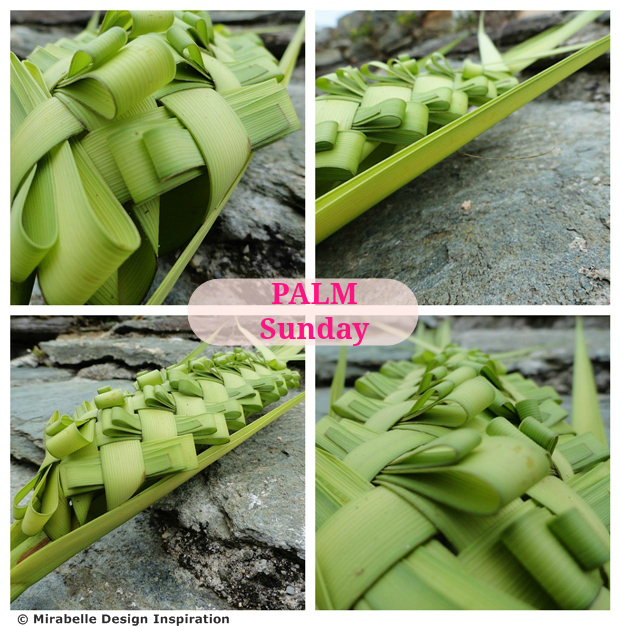
Palm Sunday Twists & Turns

In the Christian calendar, Palm Sunday (also referred to as Passion Sunday) celebrates the triumphal arrival of Jesus Christ on colt-back in the city of Jerusalem, the week before his death and resurrection, where the population welcomed him by waving palms and laying them on his path, as a sign of gratitude.


Palm Sunday heralds the start of the Holy Week, which culminates into the Easter celebrations. Traditionally Christians take palms or box, olive, willow or yew branches to their local church on Palm Sunday for those to be blessed by the priest and bring good fortune to abodes and households. The branches are kept for one year, and laid on a mantelpiece, vanity, cabinet or other chosen piece of furniture, or placed between a cross/ holy picture frame mounted on the wall and the actual wall itself. Some Christians place the blessed palms on the graves of loved ones. Some will hang a piece of palm frond woven into a cross by the rear view mirror of their car.

Now whether you are a believer or not, you cannot fail to recognise that some of those palm pieces are works of Art all to themselves as the fresh, young and tender leaves are split, bent and painstakingly interwoven into intricate patterns, creating religious representations or more abstract ones. In Corsica, the event makes the local news every year without fail, as both the religious fervour and the craft are celebrated.


However in recent years, the local palm trees have been suffering from major setbacks in the form of red palm weevil infestations brought by trade imports from the Far East, via container ships and contaminated wood pallets. As a result, it is becoming difficult to source healthy young and tender palm. Meanwhile we need to ensure that the palm-weaving craft, a fragile piece of cultural heritage, is shared and carried through from one generation to the next, or it may one day vanish altogether once the elders and other individuals in the know are gone.

Featured here is a proud example of Corsican craft applied to Corsican palm. There is a lot going on in the technique (look at those layers!), and Mirabelle is very admirative of it! So pretty in its sophisticated simplicity!


Source: All photography by Mirabelle.

22 Feb 2016

The Farce of Modern Art

Whatever falls under Fine Art needs to be treated with care. Whatever falls under Modern Art needs to be treated with caution. And this, not only as a movement but also as a composite of artists that define themselves as anything that oscillates between contemporary and post-modern, with the inevitable Conceptual Art thrown in the middle.


What You See Is What You Get (WYSIWYG), you might think, but the artist has us believe that their creation goes much deeper than their stating the obvious, that there is depth and meaning and a philosophical point of view blurted out of that fat blob of paint marring a canvas, or that incongruous growth that spikes off like a bizarre assault to the senses. That riches are to be exuded from a modern work of art that either looks like it was thrown together by a five-year-old, or whose incongruity makes it point-blank at odd to the accepted laws of beauty and balance and the classical form of talent that is meant to take an oeuvre through the times, perdure and leave an indelible mark on our collective heritage. And maybe this is where Modern Art develops into a fallacy, thus turning into its own worst enemy.


Maybe this is the frustration of Modern Art: wanting to rewrite the rules by breaking them, and the finished product failing to convince and impress as a result, as the viewers feel they are being taken for a ride. Failing the recognition and admiration and blessing of the Art community as a whole, failing to simply be Fine. Mirabelle is not here to judge, but rather to ponder a Modern Age-old concept: Is Art for Art's Sake a reason for creating Art?


Source: All photography, part of the Champagne Life exhibition currently featured at the Saatchi Gallery in London, UK, until 9th March 2016. (1) 'Moje Sabz' by Iranian artist Soheila Sokhanvari (2011). (2) 'Domestic Terrorist Burt' by American Suzanne McClelland (2014). (3) 'Untitled 21' by Canadian artist Julia Dault (2010). (4) The Truth About Modern Art, a must-watch critique by Paul Joseph Watson! - [Beware: use of strong language].

14 Jul 2015

The Tile Files: Mosaics

Welcome to Mirabelle's monthly design series, The Tile Files. So far, our celebration of enduring tile design has taken us to the south of France (Tomettes), Portugal and Spain (Azulejos), and finally north of the old continent, to The Netherlands (Delftware). This has been quite a journey of stylish discoveries!

The Cul-de-Four Mosaic, Notre-Dame de la Garde Basilica (Marseille, France)

For this month's article, we need to delve deep into the arcana of Antiquities - to the second half of the 3rd Millenium BC - in order to track back our very first Mosaics. The decorative impact of those versatile and hard-wearing tile pieces belies no diminutive potentiality! In other words, the face of Antiquity would be disfigured if stripped off them! And it appears that from Empire to technique, Byzantine rules the finesse of the art!

Mosaic tiles (Tesserae) owe their perennial popularity to ceramic (clay that is glazed or unglazed). However, earlier mosaics referred to roughly cubic, terracotta brick, cut-stone (marble, limestone, granite or onyx) or cut-glass tiles, of irregular finish. Mosaics were sometimes made out of other materials such as natural pebbles, seashells, gemstones, precious stones, or ivory fragments.

Mosaic, c.200-100BC, discovered in 1993 during the construction of the new Alexandria Library, Egypt

Mosaics are assembled together with many more in order to pave a floor, a ceiling or a wall. Their small size enables them to cover curved and/ or uneven surfaces like columns or basins. Yet mosaics do not only lend themselves to the practicality of surface covering, they also hold a high ornamental value. To do so, they are combined together according to a specific colour pattern in order to create a repeated decorative motif (tessellation) that will define a border, or create a figurine or landscape element that will be part of a 'bigger picture', a mural, medallion, or bas-relief. As mosaics tell a story, they may even incorporate a name, a date, a motto, a sacred text, or a few descriptive words and other symbology.

Manufactured processes include gold glass, that is produced according to the Byzantine mosaic technique. The latter is applied to stone, gemstone, ceramic, seashell or glass, and brings together irregularly-shaped and handcut mosaic pieces of different geometric shapes that follow the artwork lines. Stone Glass Byzantine Mosaic murals are either made out of Smalti (hand-poured and hand-cut opaque glass) or manufactured glass tiles (of uniform shape and size). Both types of glass may be cut into irregular shapes for Byzantine mosaic.

Parque Güell, Sala Hipstila (Barcelona, Spain)

Mosaics have been precious visual story-tellers, not only to archaeologists, historians, anthropologists and ethnologists, but to anyone appreciative of their testimonial accounts, as they document passages of history, capture rites of passage or moments of daily life. Through their iconographic representations, those murals have contributed to relate the history of ancient civilisations, and the making of humanity.

The ancient decorative art of mosaics has transposed well into the present day, owing to their durability, which results from their individual compact size. This confers them that extra strength, and a certain fluidity of movement (under the duress of substrate shifts) when combined with other tesserae, making them less prone to breakage and cracks. To that effect, let's note the well-preserved three-millennia old cone mosaic courtyard (made out of polychrome terracotta cones), from the ancient Sumerian city of Uruk, and the glazed brick mosaics of the Ishtar Gate of Babylon (ca. 575 BC).

The Basilica of San Vitale (Ravenna, Italy)

More recent mosaic artwork is found in the ancient city of Ravenna (Italy), former last capital of the Western Roman Empire (5th Century AD) and headquarters of Theodoric's Ostrogothic Kingdom. The Basilica of San Vitale is part of an ensemble of Early Christian Monuments of Ravenna, described as being one of the most important examples of early Christian Byzantine art in western Europe, especially noted for its remarkable mosaics. The monument is inscribed on the UNESCO World Heritage List.

Mosaics have remained popular to the present day. The specs and technique have overall remained the same, despite being updated to fit mass-production criteria. The use of the cheaper vitreous glass (i.e. cast glass), mirror, ceramic materials with or without photoluminescent effects, all cater for mass-market fads. Other substrates include aluminium or wood. New effects are achieved thanks to a wider range of geometrical shapes. Cast or hand-cut options are available, according to the finished look sought out (sleek and modern or artisan). The pre-assembled (mesh-backed) mosaic sheets have streamlined the tiling process considerably.

Inspiration Green

Mosaics not only transcend the timeline from Antiquity to the present day, but also faith, creed and cultures, as their popularity, harked back from the cradles of civilisation of the Middle East (Mesopotamia) and the Mediterranean basin (Ancient Greece and Roman Empire), has since encompassed the whole world, to decorate sacred buildings, public places, and private residences alike.

In the course of the 20th century, mosaic popularity has been illustrated all the way from major design projects (the mosaic-inspired pique-assiette technique by Antoni Gaudí in Barcelona's Parque Güell springs to mind), to the more 'mundane' panels that take pride of place in commercial or domestic kitchens or spas. Meanwhile a tile company by the name of New Ravenna will - if only by name association - ensure that the mosaic grandeur of Ravenna remains in the collective psyche, and not only so... Countless other tile companies have too capitalised upon the versatility and durability of mosaics, Porcelanosa, Agape Tile, or Original Style, to name but a few.

'Jacqueline Vine' by Sara Baldwin for New Ravenna Mosaics

This article has only scratched the surface of tesserae. You might wish to scratch it a little deeper and unveil new treasures. A quick browse through the 1000+ eclectic mosaic collections from The Metropolitan Museum of Art will reveal more about mosaic versatility. Meanwhile Agape Tile has an interesting potted history section on Ceramic Tiles, and so does Designboom.

In next month's episode of the Tile Files, we will be gazing at the wondrous world of Majolica, in all its Florentine grace and Victoriana, and unfold more visual treasures along the way! Be there or be square!

'Avila' by Paul Schatz for New Ravenna Mosaics

Sources: (1) 'Mosaïque du Cul-de-Four de l'Abside', detailed iridescent Byzantine mosaic in the apse of Notre-Dame de la Garde Basilica, Marseille France. Photography by Robert Valette, via Wikipedia. More from Basilique Notre Dame de la Garde. The Basilica stands out in its hilltop Neo-Byzantine grace, that so befits the muted exoticism that exudes from its hometown of Marseille, known as the doorway to the Orient (la porte de l'Orient). Despite the church edifice dating back to 1864, the religious history of the place originates back to 1214, where a chapel once stood. (2) An antique advertisement for His Master's Voice or Tickle's ancestor? Mosaic floor depicting a dog and a knocked-over gold vessel, via Urge to Create. The c.200-100BC mosaic was discovered in 1993 during the construction of the new Alexandria Library, Egypt. It now sits in the Greco-Roman Museum in Alexandria. The tiny size of the tesserae (only 1-2mm across), allows great detailing and a painting-like effect. The technique was known in Antiquity as opus vermiculatum (‘worm-like work’). The photo originates from a book by Susan Walker and Peter Higgs, Cleopatra of Egypt. From History to Myth, Princeton University Press (2001). (3) Sala Hipstila, Parque Güell, Barcelona Spain, via Europaen Fotos. (4) id., via Park Güell. (5) 'Interior of San Vitale' (Ravenna, Italy), photography by Lawrence OP, via Flickr (July 2013). The Basilica of San Vitale is a jewel of early Christian art, featuring rich mosaic frescoes. The Mausoleum of Galla Placidia is equally sumptuous. More from Ravenna, Turismo e Cultura (Ravenna's official tourism website). (6) Cob bathroom, via Inspiration Green. (7) 'Jacqueline Vine', a jewel glass waterjet mosaic shown in 'Amethyst', part of the Silk Road Collection by Sara Baldwin for New Ravenna Mosaics. (8) 'Avila', a natural stone waterjet and hand-cut mosaic shown in 'Gold glass honed', 'Afyon White polished', and 'Cloud Nine honed', part of the Miraflores Collection by Paul Schatz for New Ravenna Mosaics.

12 May 2015

The Tile Files: Azulejos

Welcome to Mirabelle's brand new monthly design series, The Tile Files. Forget "Be There or Be Square", as square wasn't a shape we started off with last month! Instead we went for hexagonal, paying particular attention to the Provençal Tomettes. This month is a different set of rules as we are up for flamboyance and opulence as a resonance of one to the other. We are about to admire those highly-decorative hand-painted tin-glazed ceramic tiles - mostly blue in colour - that are described as the pillar (elements) of traditional architecture in Portugal, Spain and their former colonies of Latin and South America. The tile technique is also found in The Philippines. Anyway why go cryptic when Azulejo is our brightly-coloured answer!

Paróquia de Santa Marinha de Cortegaça

As tempted as we might be to associate Azulejo with Azul ('blue' in Spanish), it derives in fact from Arabic Zellige ('polished stone'), a tile decoration technique directly influenced by Roman mosaics and later perfected by the Hispano-Moresque.

Azulejo is a tale of brio and panache: it is meant to get your attention! The colour that traditionally defines the azulejo is blue, due to the fact that when the artform had reached its pinnacle in the 17th century, it was being influenced by the white and blue duo scheme from the Ming Dynasty porcelain. The traditional azulejo focuses upon a palette of blues which, in their hues and effects, provide depth and perspective against a neutral (i.e. white) background. Yet in earlier times, azulejo included richer and warmer colourways, as testified by La Alhambra de Granada (Spain). 

Plaza de España, Sevilla

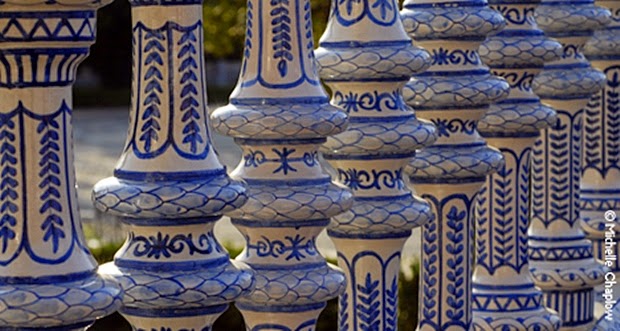
Azulejo may present itself bare in design, or overly intricate and ornate and therefore suited to the more baroque architecture. It may ornate church façades, imposing state and public buildings, and private residences, not to mention street infrastructures (fountains, benches, signage, or even bridge balustrades). The latter's most famous depiction as a testimony to the craft, is visible on Plaza de España (Seville), as part of the ensemble erected for the Ibero-American Exposition of 1929, an altogether landmark example of the Spanish Renaissance Revival style.

Not only are azulejos found in the great outdoors, but also in the great indoors, where they clad the floors, walls, ceilings and courtyards of monasteries, churches, universities, public buildings and private houses alike, sometimes in pure carpet style decoration where they enrobe every curve and movement of a surface, including arches, window surrounds and seats. Ornate tiles may be used as a decorative accent, as a border (frieze) or lintel, or more dramatically repeated over as a single motif piece, from floor to ceiling.

Azulejo Portuguese

Azulejos may be abstract or figurative in design, with earliest examples of azulejo being purely geometric as they were directly influenced by zellige. Each individual piece of tile may be painted in such a way that it represents only a fragment of a design element that is part of a bigger picture once assembled together with other tiles in a definite sequence in order to form a fresco or a mural, where it may go beyond the decorative and the trompe l'oeil, by relating a story, depicting a religious scene or edifice, or commemorating a battle.

Beyond the ornamental value of azulejos lies a more practical reason: the tiles keep interiors fresh during the Summer months, and dry during the rain season. The tile heritage has remarkably lasted well into the present day. Six centuries on, azulejos are still being produced, to the delight of design connoisseurs and tradition lovers, either through loyal representation of classic style, or in a more avant-garde albeit surrealistic interpretation, as seen in the Lisbon metro stations and La Casa de Música (Porto).

There certainly is a remarkable symbiosis between the solemnity of stone and the merry sobriety of tile, like a cheerful candy package cleverly unwrapping parts of a candy, as encapsulated by La Igreja Matriz de Cambra:-

Igreja Matriz de Cambra, Vouzela, Portugal
Casa de los Azulejos

Upon those sweet considerations, The Tile Files are tip-toeing out of those magnificent monuments. We will be back next month, yet should the prospect of the wait make you feel blue - you have every reason to feel that way - as our next visit will take us north to explore a close variant of azulejo - therefore expect more hues of blues!

Sources: (1) Paróquia de Santa Marinha de Cortegaça, Portugal, via Metalocus. Additional information about the flamboyant church, via Wikipedia (in Portuguese). Original photography by Markus Brunetti, part of his 'Façades: Kathedralen, Kirchen, Klöster in Europa' 2014 photographic exhibition. (2) Bridge balustrade, Plaza de España, Sevilla, photography by Michelle Chaplow, via Andalucia.com. (3) Azulejo Portuguese, part of the Azulejos Portugueses album by rhox2, via Flickr. More azulejo delights from the Azulejo Flickr group! (4) Igreja Matriz de Cambra, Vouzela, Portugal, photography by Sandra Coutinho, via Wikipedia. (5) Interior courtyard of Casa de los Azulejos, Mexico City, photography by Anthony Sloan, © Estate of Anthony Vail Sloan, 2009.

Additional Resources:

15 Apr 2015

The Tile Files: The Hex Factor

Welcome to Mirabelle's brand new monthly design series, The Tile Files. I am passionate about design and what makes a house look balanced, in terms of style identity. Flooring - and in particular floor tiles - feature prominently in my life as an amateur interior designer. A strong observation resulted from this: having had the privilege to visit dozens of properties throughout my life, what I have repeatedly and consistently noticed is how the choice of flooring impacts either positively or negatively upon the overall look and character of a property. It either enhances it considerably - or it unabashedly ruins it!

Exquisite Surfaces

This certainly was the case when a couple of years ago, some friends proudly showed me photos of their house in Normandy (northwestern France) that they had just put up for sale. The kerb appeal was enticing, lovely quaint 19th century country house in a mature garden, with period features retained. However as soon as you pushed the front door, shock horror! You were confronted with a 1980s revisit, complete with the open plan situation that had totally wrecked the expectations, and the cheap and nasty square glazed white tiles grouted black - my pet peeves! What we were left with was a house that had lost its charm and identity altogether.

The Metropolitan Museum of Art

However in this series, we will leave design mistakes aside and explore those classic and timeless designs, that have transcended decades - even centuries - and still to this day have stood the test of time, in terms of classical style.

ARTO's concrete versions of the Tomette

Let's start off with the Tomette, the tile that is traditionally associated with the Southern France (Provence and Corsica) of yesteryear. Tomette is a glazed hexagonal clay terracotta tile, in rich earthly tones, sizes may differ. Tomettes have the advantage of keeping a house cool in the Summer. My grandma's house in Corsica had its ground floor tiled in red tomettes, back in 1907, when the family house underwent extensive renovation, still in keeping though with the character of the house.

From personal investigations in unaltered older Corsican properties, I found out that traditional tiles were mostly square-shaped. However hexagonal tiles became vastly popular in the 19th century, up to WWI. I understand they brought a status symbol of comfort and social advancement to houses. After WWI, the popularity of the tomette declined steadily in favour of style incongruities for the older house that, despite bringing urban and modern into the home, defaced the character of many an older property: Granito, Formica, Linoleum, those throughout the 1950s and 60s.

Uncredited picture, via Tumblr

These in turn paved the way for cheap southern imports of mass-produced style-less charmless ceramic tiles. Meanwhille it seems that, driven by market demand for low production costs and a stiff competition from abroad, many a French tile company lost its way, in terms of design.

Fortunately out there, tile designers in the know are aware of the importance of legacy, tradition and sobriety of style. They have realised that old didn't have to mean old-fashioned. And why fix something that is not broken? Thus I am pleased to acknowledge the fact that those traditional French designs of yesteryear are now regaining some popularity on the home turf, while being praised and appreciated outside of France by connoisseur suppliers and customers.

Tabarka Studio
Tabarka Studio

To name but a few of those American tile companies supplying hexagonal terracotta tiles: Exquisite Surfaces, ARTO and Tabarka Studio. Click the links to find out about showrooms, resellers and distributors.

Meanwhile The Tile Files will be back next month, and we'll hit the tiles once more... with grace!

Sources: (1) Made in France, those Antique Hexagon Terracotta Tiles are available in traditional colors from Exquisite Surfaces who describe the tiles herein: "Nothing symbolizes French country flooring more than terracotta. The extraordinary warm colors, the beautiful hues and variations, the hand-molded shapes all define the essence and rustic charm of French country living."

(2-3) Those 15th century hexagonal tiles from New York's Metropolitan Museum of Art testify to the fact that hexagonal is no contemporary tile shape! (2) Hexagonal Tile from Mamluk Egypt, featuring a botanical design. The design of this tile was strongly influenced by Chinese models, in both composition and color. (3) Hexagonal Tile of Islamic culture found in Egypt, featuring the palms of a palm tree.

(4) Collage of four of ARTO's versatile interior/ exterior floor and wall concrete hex tiles that mimic the variegations and handcrafted elegance of terracotta, with extra durability. Clockwise from top left: {1} BB30 6'' Hexagon Normandy Cream Signature Series Tile; {2} BB173 6'' Hexagon Los Angeles Red Flash Vintage Tile; {3} BB44 6'' Hexagon Crème Fraîche Vintage Tiles; and {4} BB174 6” Hexagon San Clemente Vintage Tiles. All of the ARTO products are manufactured with concrete. Production has taken place in Southern California since 1966, in pure artisan style. Besides, all ARTO products are recyclable, and the company is a proud member of the U.S. Green Building Council. More details from their general brochure.

(5) Uncredited picture, via Beautiful Portals, describing the passing of time, and a once-cherished home somewhere in the Middle East now surrendered to the elements. Let's not just pay attention to the bright decorative tiling but also to the intricate frieze details.

(6-7) Tiles by Scottsdale-based Tabarka Studio. (6) Adama 5 (Hex) Artisan Hexagonal Terracotta Tiles are available in organic terracotta shades. "Signifying Earth in Hebrew, (Tabarka's) Adama collection of artisan terracotta tiles have an aged appearance offering the look and allure of centuries old terracotta. Rich in texture and extreme in color variation, these handmade tiles are truly an artisan creation in which no two pieces are exactly alike." (7) Izmir 1 Hexagon Terracotta Floor Tiles add splashes of pattern to floor.

Reclaimed tomettes available from BCA Antique Materials.

4 May 2014

The Leafy Quarters

If your inner India Hicks awakens the wish for your abode to adopt the stylish beach house interior with a Southern Colonial/ Caribbean feel warmed up by a lush yet breezy exotic vibe that includes a larger-than-life leaf motif of the palm variety, you want to check out three classic patterns that make a timeless design chic statement - faultlessly and effortlessly.

Match with white painted woodwork in a satin finish. Cool down with an imposing vintage ceiling fan. Accessorise with rattan pieces (and that peacock chair!), plates of decorative pineapple and other exotic fruit for visual interest, and lashes of colourful curcuma and protea. Serve with Daiquiris. Infinity pool and pet parakeet optional.

1  - Voyage of Discovery WallpapersManila in Green and Ivory DVOY213367, by Sanderson


Source: 1a - 1b - 1c

2 - The Original Martinique Wallpaper a.k.a. Martinique "A" BH90210, Originally Designed for the Beverly Hills Hotel Fountain Coffee Room in 1942


Source: 2a - 2b - 2c

3 -  Custom-Designed Wallpaper by Idarica Gazzoni for Arjumand Wallpapers, as Featured at the LIZA Restaurant, East Beirut, Lebanon


Source: 3a - 3b - 3c
Related Posts Plugin for WordPress, Blogger...